

Organ transplantation remains governed by an unforgiving clock. Once removed from the donor, an organ begins accumulating ischemic and metabolic damage. Cooling slows this deterioration, but conventional preservation still leaves transplant teams working within a window measured in hours.
Recent experiments have now extended both extremes of that timeline.
In vitrification, technique which is promised to allow for indefinite organ biobanking, Dr Brian Wowk, Dr Gregory Fahy and colleagues successfully vitrified, rewarmed and transplanted a 13.9-gram rabbit kidney, establishing the current record for the largest vitrified vital organ returned to clinically normal function. A separate team led by Dr Wei Rao and Dr Jing Liu subsequently demonstrated the first successful allogeneic transplantation of a vitrified rabbit kidney using a liquid-metal-assisted heat-transfer system.
In supercooling, technique that is promised to solve organ waste due to donor-recipeint distance, Dr Matthew Powell-Palm and collaborators have now reported transplantation of pig kidneys after as long as 72 hours of ice-free storage at approximately −4°C, without the use of (toxic) cryoprotectants. This appears to be the longest reported supercooling period for a transplanted kidney and the first demonstration at this duration in a large-animal kidney model.
Some cryo background, if you’re new here:) (skip if you’re a pro)
Vitrification aims to stop this clock much more completely. Instead of allowing water to organize into damaging ice crystals, an organ is perfused with a concentrated cryoprotective solution and cooled until it enters an amorphous, glass-like state. Unlike conventional freezing, vitrification does not produce an organized crystalline structure that can rupture cells and blood vessels.At sufficiently low temperatures, molecular movement and chemical reactions become extremely slow. A vitrified organ could therefore, in principle, remain stable for months, years or longer without the continuing ischemic deterioration seen during conventional cold storage. The hardest parts are not maintaining the organ at cryogenic temperature, but getting it safely into and back out of the vitrified state.
First, enough cryoprotectant must reach every part of the organ to suppress ice formation. These compounds can themselves cause chemical toxicity, osmotic stress and cellular dehydration, particularly at the high concentrations required for organ vitrification. Cooling must then be fast and uniform enough to prevent ice while avoiding excessive thermal stress. Rewarming may be even more difficult. A solution that vitrified successfully during cooling can still crystallize as it passes back through intermediate temperatures. The organ must therefore be warmed faster than its critical warming rate. At the same time, uneven heating can make the surface and interior expand at different rates, generating enough mechanical stress to crack the vitrified organ.
Traditional warming from the outside becomes progressively less effective as organ size increases. The surface may overheat while the centre remains trapped within the temperature range in which ice can form. This size-dependent rewarming problem is why volumetric approaches—including nanowarming, dielectric heating or liquid-metal-assisted system (latest breakthrough) have become so important. Rather than waiting for heat to diffuse slowly from the surface, these technologies attempt to generate or distribute heat throughout the organ.
Supercooling takes a less extreme approach. The organ is cooled below water’s normal freezing point but remains liquid: it is neither frozen nor converted into a glass. Lowering the temperature further than conventional cold storage suppresses metabolism and slows deterioration, while avoiding the high cryoprotectant concentrations and extreme rewarming requirements associated with vitrification.
The trade-off is that a supercooled organ remains biologically and chemically active. Supercooling can slow biological time for days, but it does not stop it for months or years. The liquid state is also metastable: although no ice is initially present, a microscopic impurity, surface defect or mechanical disturbance can trigger nucleation and rapidly freeze the entire organ. Once ice begins forming, it can cause the same structural damage that supercooling was intended to prevent.
Supercooling has already produced transplantable organs in other models. In 2014, rat livers were preserved in a non-frozen state for up to four days before transplantation, tripling the viable preservation duration in that model. The latest reported pig-kidney experiments are especially relevant because porcine kidneys are much closer to human kidneys in size and surgical anatomy.
The two technologies therefore solve different versions of the same problem. Supercooling could extend today’s transplant window from hours to days, creating more time for transport, matching and surgery. Vitrification aims to make the window effectively open-ended, enabling true organ banking—but requires the organ to survive much more demanding cryoprotectant loading, cooling and rewarming procedures.
The largest vitrified organ successfully transplanted
In May 2025, researchers from 21st Century Medicine published the results of a 55-megahertz dielectric warming system designed to rewarm vitrified organs rapidly and uniformly. Of three rabbit kidneys that were vitrified, dielectrically rewarmed under slightly different conditions and transplanted, one recovered long-term function. The kidney weighed 13.9 grams, approximately an order of magnitude more than the rat kidneys used in the landmark 2023 nanowarming transplantation study.
The recipient’s serum creatinine eventually fell below 2 mg/dL, a level the researchers characterized as clinically normal renal function. The rabbit was still alive 17 months after transplantation when the study was prepared for publication (Wowk et al., 2025). The authors described the kidney as the largest vitrified vital organ successfully returned to clinically normal function to date.
When it comes to rewarming, Wowk’s system generated an oscillating electric field between capacitor plates. Water and cryoprotectant molecules throughout the sample absorbed energy from the field, allowing the kidney to be heated volumetrically rather than relying entirely on conduction from its surface. In physical experiments, the 800-watt system produced peak warming rates close to 200°C per minute in approximately 15-gram rabbit kidneys contained within a total volume of around 45 mL. Computer modelling was used to optimize the capacitor plates, organ container and surrounding dielectric materials to make the internal electric field more uniform.
The experiment established that a rabbit-sized kidney can survive vitrification, rapid dielectric rewarming and transplantation with recovery of clinically normal function.
It did not yet demonstrate that this outcome can be produced consistently. Only one of the three transplanted kidneys achieved long-term recovery.
Wei Rao’s liquid-metal route to rabbit-kidney vitrification
Less than a year later, researchers led by Wei Rao and Jing Liu at the Technical Institute of Physics and Chemistry of the Chinese Academy of Sciences reported another route to vitrifying and transplanting a rabbit kidney.
Published in Matter in March 2026, the study introduced a flexible composite made from a eutectic gallium–indium liquid metal mixed with polyvinylpyrrolidone.
What are liquid metals?
Liquid metals are metals or alloys with melting points near or below room temperature, combining the thermal and electrical conductivity of a metal with the ability to flow and conform to complex shapes. Rao’s team used eutectic gallium–indium—an alloy containing approximately 75% gallium and 25% indium—mixed with polyvinylpyrrolidone to create a flexible heat-transfer composite. Beyond cryopreservation, gallium-based liquid metals are being explored in stretchable circuits, wearable sensors, neural interfaces, soft heaters and robotics, while nanoscale formulations have been investigated for drug delivery, medical imaging and cancer treatment although most biomedical applications remain experimental rather than clinically validated (but check out Dr Rao’s papers because the POCs are fantastic! I pulled an all-nighter reading them - couldn’t stop.
The video above is taken directly from Dr Rao’s paper. It shows step by step how the experiment was conducted. It is my first time seeing such a video in a paper and I LOVE IT! It’s such a good way to engage with a reader and let them immediately grasp the gist before getting into the details - can more of us do it, please?
The material was placed around the rabbit kidney, where it closely followed the organ’s irregular surface, and introduced into its vascular network. The external layer conducted heat into the organ while the intravascular material generated heat under an electromagnetic field, allowing the kidney to warm from both outside and within and reducing the temperature gradients that can cause ice formation or cracking. A gelatin transition layer enabled the material to be removed and recycled after rewarming. Importantly, the liquid metal did not replace conventional vitrification cryoprotectants; it acted primarily as a high-conductivity rewarming system. The liquid metal raises conductivity, reduces contact resistance and improves heat distribution. The organ must still be placed in conditions that prevent ice formation during cooling and rewarming i.a use cryoprotectants like DMSO, propylene glycol, trehalose etc.
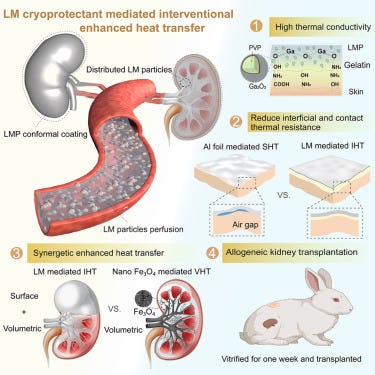
The proposed advantage is straightforward: instead of allowing heat to travel slowly through poorly conductive biological tissue, the liquid metal creates what the authors describe as a thermal highway around and through the organ. The material had a reported thermal conductivity of 9.3 W/m·K, approximately 10.3 times greater than that of the iron-oxide-containing cryoprotectant formulation used as a nanowarming comparator. Because the flexible material conformed closely to the organ surface, it also reduced the insulating gaps and interfacial resistance that can occur when a soft, irregular organ is placed against a rigid warming material.
Across the tissue experiments, the system reduced maximum surface-temperature differences by between 10°C and 41.9°C and lowered calculated thermal stress by approximately two orders of magnitude. Compared with water-bath controls, post-rewarming viability increased 1.7-fold in rabbit skin and 3.6-fold in arteries.
The vitrified and rewarmed kidneys maintained sufficient morphology and function to enable the first successful allogeneic transplantation of a vitrified rabbit kidney, with the graft recovering enough renal function to support the recipient’s survival.
The Rao platform may also be more adaptable to organs with complex or irregular geometries because the heat-transfer material can conform to the surface and use vascular channels to distribute heat internally.
Supercooling record: time + size + transplant
In January 2026, a peer-reviewed study published in the American Journal of Transplantation in 2026 provided the first major large-animal evidence. Calderon Novoa and colleagues preserved pig kidneys for five hours or for prolonged periods of 24 to 48 hours at subzero, nonfreezing temperatures and subsequently assessed them using porcine autotransplantation. The study concluded that subzero kidney preservation was feasible and could be followed by transplantation, although the authors emphasized that the protocols still required optimization. However, the University of Toronto group didn’t get much time to enjoy their record-bearing title, because just 5 months later, in July 2026, Dr Matthew Powell-Palm and collaborators have now reportedly extended supercooled pig-kidney preservation followed by transplantation to 72 hours.
This work is based on isochoric supercooling, meaning that the preservation solution and biological sample are enclosed within a rigid chamber at constant preassure. The kidneys were maintained at approximately −4°C without ice formation and without the concentrated permeating cryoprotectants used in vitrification. Experimental groups reportedly included kidneys stored for 24, 48 and 72 hours before being transplanted back into pigs.
According to reporting on the study, the 72-hour grafts reperfused after transplantation and recovered renal function during a 30-day observation period. The young pigs continued growing, while the transplanted kidneys enlarged as they compensated for both the animals’ growth and the absence of a second functioning kidney. Can’t wait for the full paper to be published!
Conclusion: A global and increasingly commercial race
The large-organ cryo world is no longer USA-centric
Dr Rao’s achievement is a clear signal that China is not being left behind in the race to bank organs. Her result emerged from the Chinese Academy of Sciences’ Liquid Metal and Cryogenic Biomedicine Research Center, supported by a growing pipeline of government-backed work: Dr Rao now leads more than 20 projects, including a 2024–2029 CAS strategic project specifically focused on temperature control for organ cryopreservation and a separate program aimed at commercializing organ-perfusion equipment. Her team has already developed a domestically designed multi-organ perfusion platform spanning temperatures from approximately 37°C to −10°C. Nor is this an isolated laboratory. China has long-running cryobiology programs at institutions including the Shanghai University of Science and Technology’s Institute of Biothermal Systems (currently led by Dr Yi Xu) —whose roots extend back to 1984—and the University of Science and Technology of China’s Intelligent Cryogenic Biomedical Engineering Laboratory. The Society of Cryobiology’s current president, Dr Xiaoming He, leads his own cryo lab at Tsinghua International Graduate School in Shenzhen. And there are ~many~more. The liquid-metal kidney study should therefore be read not simply as one remarkable paper, but as evidence that sustained institutional funding, specialized engineering infrastructure and a growing domestic research network are beginning to translate into landmark organ-preservation results.
My bet is that organ and whole-organism cryobiology will enter China’s upcoming or next 5-year-plan. When China designated BCI as a strategic future industry, the field rapidly gained coordinated funding, clinical programs, standards, industrial clusters and state-backed companies, and now there is no doubt that China leads the industry. Cryobiology could follow the same path: shared large-animal facilities, domestic perfusion and rewarming platforms, dedicated translational grants and faster commercialization.
Cryo industralization and race towards an integrated platform
Dr Powell-Palm’s work points toward an equally important commercialization story in the United States. He co-founded BioChoric in 2021 with UC Berkeley professor Boris Rubinsky to translate isochoric supercooling into practical preservation systems, and now serves as President of the newer biostasis venture Maximize Bio. So it’s quite obvious that his research is gearing up to become major competition to established organ-preservation businesses such as TransMedics and XVIVO (read more about them in this regeneration.ai post ). If Maximize Bio can reproduce 72-hour preservation reliably, scale the device across organs and demonstrate clinical safety, the competitive boundaries could change quickly: preservation would no longer require keeping an organ continuously “alive” on an expensive machine. The bigger conclusion is that organ preservation is becoming a platform industry. The likely winners may not be companies committed to one temperature or one device, but those capable of moving organs safely across the full spectrum from perfusion, through supercooling, to eventual vitrification and true organ banking.
Let's check out the Liquid Metals tech
Talking about stuff coming out from China, what about this lab? https://pubmed.ncbi.nlm.nih.gov/31461026/
Are those results credible at all?