

Organ storage technology has transformed how we preserve donor organs for transplantation. Traditional cold storage methods limit viability to mere hours, but automated perfusion systems, often called “boxes”, pump oxygenated fluids or blood through organs, mimicking the body’s environment to extend preservation times, assess functionality, and boost transplant success rates. These devices use either hypothermic (cold) or normothermic (body-temperature) perfusion to keep organs alive longer, reducing discard rates and expanding the donor pool. Based on recent industry analyses, here are the leading companies in this space as of March 2026. I’ve focused on those with automated, portable perfusion systems, drawing from market reports and company details. I’ll explain each company’s key tech, how it works, and the comapny’s market situation.
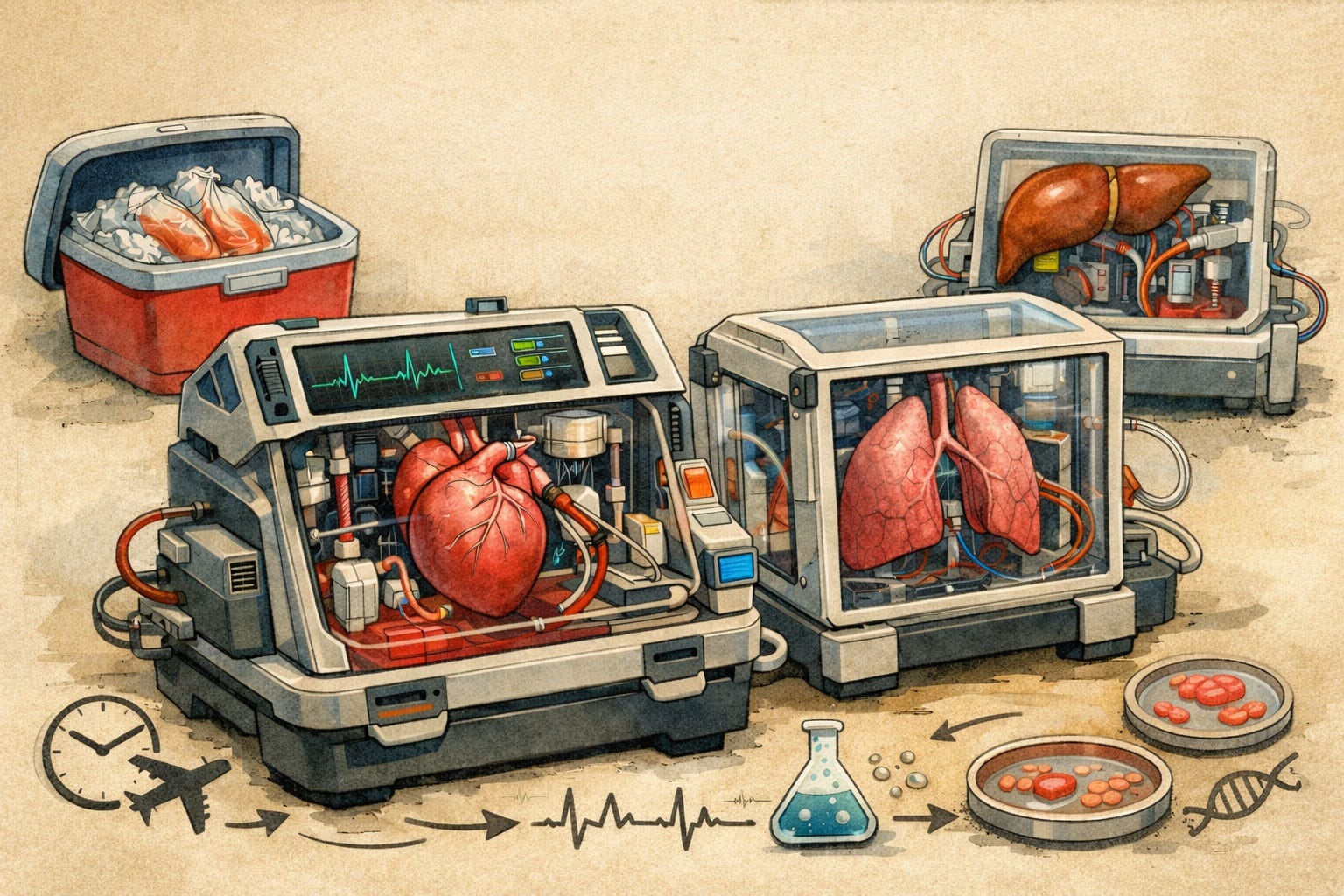
Today’s reality in the operating room
As of 2026, static cold storage (SCS) remains the predominant standard method of donor organ preservation worldwide. This involves flushing the donor organ with a specialized cold preservation solution (typically at 4°C, such as University of Wisconsin solution or histidine-tryptophan-ketoglutarate) to remove blood and reduce metabolic activity, then storing it in a sterile triple bag or container packed with ice in a cooler for transport. This simple, cost-effective, and portable technique slows cellular metabolism and minimizes ischemic damage, allowing preservation times of 4-6 hours for hearts, 6-8 hours for lungs, 12-24 hours for kidneys, and up to 12-15 hours for livers, depending on the organ. While effective for standard donors, SCS has limitations, such as increased risk of graft dysfunction with extended times or marginal organs, leading to higher discard rates. So what are the companies whose products address that?
1. TransMedics
TransMedics is a frontrunner in normothermic machine perfusion (NMP), with their Organ Care System (OCS) platform approved for heart, lung, and liver transplants in the U.S. The OCS is a portable “box” that keeps organs functioning ex vivo by circulating warm, nutrient-rich, oxygenated blood or a blood-based solution through them, essentially replicating the body’s conditions. This contrasts with hypothermic methods by keeping the organ metabolically active rather than slowing metabolism, which enables therapeutic interventions (e.g., adjusting electrolytes or administering medications) and functional evaluation during preservation. As of 2026, the OCS is FDA-approved for both donation after brain death (DBD) and donation after circulatory death (DCD) indications across heart, lung, and liver transplants in the U.S., and it’s CE-marked in Europe. Clinical benefits include lower rates of early allograft dysfunction (EAD, e.g., an 13% reduction compared to cold storage for livers), improved graft survival, and expanded use of marginal donor organs. Moreover, the comapny has their own aircraft fleet to further ease the supply chain for transplantation. I was also very happy to see that they have an extensive body of peer reviewed publications on the effect of their system on organs, as well as economic impact on the “industry”, for the lack of better word.
How it works: The OCS is a fully portable, multi-organ system that uses normothermic (body-temperature, approximately 34-37°C) perfusion to mimic the human body’s environment, perfusing organs with warm, oxygenated, nutrient-enriched donor-compatible blood (often collected from the donor or supplemented). This contrasts with hypothermic methods by keeping the organ metabolically active rather than slowing metabolism, which enables therapeutic interventions (e.g., adjusting electrolytes or administering medications) and functional evaluation during preservation. As of 2026, the OCS is FDA-approved for both donation after brain death (DBD) and donation after circulatory death (DCD) indications across heart, lung, and liver transplants in the U.S., and it’s CE-marked in Europe. Clinical benefits include lower rates of early allograft dysfunction (EAD, e.g., an 18% reduction compared to cold storage for livers), improved graft survival, and expanded use of marginal donor organs.
OCS Heart: The system perfuses the donor heart with warm, oxygenated blood via the aorta, allowing it to continue beating rhythmically as it would in vivo. This is achieved through a sterile perfusion module that houses the organ, circulates blood, and maintains homeostasis (e.g., pH, oxygenation). Real-time monitoring includes ECG waveforms, aortic pressure, coronary flow, and lactate levels to assess viability and detect issues like arrhythmias or ischemia. Preservation times surpass the 4-6 hours typical of cold storage, enabling cross-country or international transport.
OSC Lung: The device combines perfusion with mechanical ventilation: lungs are inflated/deflated cyclically while perfused with warm blood through the pulmonary artery. This allows the lungs to “breathe” and exchange gases, improving condition by recruiting alveoli and clearing secretions if needed. Diagnostics focus on gas exchange metrics (e.g., PaO2/FiO2 ratio), bronchoscopy access for evaluation, and parameters like pulmonary vascular resistance. It supports extended preservation and is approved for both standard and expanded-criteria lungs, reducing primary graft dysfunction risks.
OSC Liver: The liver is perfused via the hepatic artery and portal vein with warm blood, sustaining metabolic functions such as bile production, glucose regulation, and lactate clearance. The system includes automated controls for flow rates, pressure, and temperature, with a bile collection reservoir for quantitative assessment. Monitoring tracks hemodynamic parameters (e.g., portal vein flow), biomarkers (e.g., ALT/AST enzymes), and bile output to evaluate graft quality and predict post-transplant performance. Viable times are extended, minimizing reperfusion injury and supporting DCD/DBD livers that might otherwise be discarded.
Financials and Market Status: As a publicly traded company (NASDAQ: TMDX), TransMedics boasts a market capitalization of approximately $4.4 billion as of early March 2026, with its stock price around $135, reflecting a 104% increase over the past year despite volatility. For 2025, the company reported full-year revenue of $605.5 million (up 37% YoY) and net income of $190.3 million, turning profitable at scale. Fourth-quarter 2025 revenue reached $160.8 million (32% YoY growth), with optimistic 2026 guidance emphasizing strategic initiatives for continued expansion. Trading at 56 times forward earnings, it’s viewed as “expensive” but promising, with analyst fair value estimates ranging from $144 to $240 per share, underscoring its leadership in reinventing transplant logistics amid high demand.
2. XVIVO Perfusion
XVIVO, a Swedish company, specializes in ex-vivo organ perfusion across multiple organs, with a portfolio including hypothermic, normothermic, and sub-normothermic options. Their PERFADEX Plus static cold-storage lung preservation solution is used in over 90% of lung transplant clinics worldwide, emphasizing oxygenated perfusion to maintain cellular health.
How it works:
Kidney Assist Transport: A portable hypothermic pulsatile perfusion device that pumps cold, oxygenated solution through the kidney’s vessels for up to 24 hours, reducing ischemia damage.
Liver Assist: Flexible protocols for hypothermic oxygenated perfusion (HOPE/DHOPE) or normothermic perfusion, circulating fluids to support metabolism and assess viability.
XPS (Ex-Vivo Lung Perfusion): An integrated platform that perfuses and ventilates lungs with oxygenated solution, allowing functional testing like gas exchange.
Key features: Customizable temperatures, real-time monitoring, and compatibility with their PERFADEX Plus solution for lung preservation. This tech extends preservation, enables organ evaluation, and boosts utilization rates.
Financials and Market Status: Publicly listed on Nasdaq Stockholm (XVIVO.ST), XVIVO Perfusion has a market capitalization of around $600 million as of March 2026, with its stock trading at approximately $19.82. Trailing twelve-month revenue stands at 812 million SEK (about $77 million USD), with gross profit of 599 million SEK and EBITDA of 138 million SEK, though quarterly revenue growth dipped slightly by 0.6% YoY recently. The company targets EBIT over 20% and EBITDA over 30% by 2027, focusing on profitable growth in its dominant lung transplant segment amid a stable Nordic market position
3. OrganOx

OrganOx focuses on liver preservation with their metra system, a fully automated NMP device that’s FDA-approved and used globally. It’s designed to keep livers viable for extended periods under near-physiological conditions.
How it works: The metra perfuses the liver with oxygenated blood at body temperature, maintaining functions like bile production and glucose metabolism. It automates fluid circulation, temperature control, and monitoring, preserving organs for up to 24 hours (12 in some regions).
Key features: Viability testing during perfusion, procedural optimization, and a user-friendly interface. This allows clinicians to assess organ quality in real-time, reducing uncertainty.
Financials and Market Status: Acquired by japanese Terumo Corporation in August 2025 for a reported $1.5 billion valuation, OrganOx is now integrated into a larger medtech ecosystem, marking one of the UK’s largest medtech exits. Prior to acquisition, it raised $45.4 million across nine funding rounds, with the latest Series D in February 2025. Post-acquisition, Terumo projects OrganOx to contribute about 9 billion JPY (roughly $60 million USD) in revenue for the five-month period from November 2025 to March 2026. As a subsidiary, it benefits from Terumo’s resources, strengthening its market position in liver perfusion amid growing demand for normothermic technologies
4. Paragonix Technologies

Paragonix offers advanced hypothermic oxygenated preservation and transport systems for heart, liver, lung, and kidney, bridging the gap between static cold storage and full perfusion. Acquired by Getinge in 2024, their devices emphasize controlled cooling with monitoring.
How it works: Systems like SherpaPak (heart), LIVERguard (liver), and BAROguard use hypothermic oxygenated technology to maintain a stable cold environment (without freezing) while circulating minimal fluids for oxygenation. Real-time tracking via the Paragonix App monitors temperature, location, and pressure.
Key features: 24/7 clinical support, integration with GUARDIAN registries for data-driven insights, and extended transport times over traditional ice boxes.
Financials and Market Status: Acquired by Getinge in September 2024 for $477 million, Paragonix was previously private and had raised $39.3 million in funding, including a $24 million Series B in 2023. Specific revenue figures are not publicly disclosed post-acquisition, but as part of Getinge (market cap ~$5 billion), it contributes to the parent’s cardiovascular and life sciences segments. Market-wise, the acquisition enhances Paragonix’s global reach, positioning it as a key player in hypothermic transport amid investor interest in organ preservation innovations.
5. Bridge to Life

Bridge to Life provides hypothermic oxygenated perfusion solutions, with the VitaSmart system as their flagship for liver preservation. They’re known for simplicity and FDA-cleared innovations in HOPE technology. It’s the first FDA-cleared HOPE device in the U.S.
How it works: VitaSmart pumps cold, oxygenated solution through the organ’s vessels, maintaining viability during transport and storage. It’s automated for ease, focusing on nutritional perfusion to prevent reperfusion injury.
Key features: Portable design, compatibility with their Belzer UW solutions, and global support for procurement.
Finantials: As a private company, Bridge to Life does not disclose detailed financials publicly. It has a history of strategic growth through acquisitions, including Organ Recovery Systems in 2019, and is backed by experienced leadership with a track record in medtech financings exceeding $1 billion aggregate. Market-wise, it holds a strong position in organ preservation solutions, focusing on improving transplant success in a growing sector, though specific revenue or valuation data remains proprietary.
6. Organ Recovery Systems

A pioneer in hypothermic machine perfusion, Organ Recovery Systems’ LifePort series is trusted for kidney and liver, with over 275,000 kidneys preserved since 2003.
How it works: LifePort Kidney/Liver Transporters pump a cold physiologic solution through the organ in a sterile, sealed environment, with pulsatile flow for kidneys and precision control for livers (hepatic artery/portal vein). It combines dynamic perfusion with backup static storage.
Key features: Portable for air/ground travel, encrypted data transmission, intuitive app with multilingual training, and visual flow confirmation.
Impact: Boosts 1-3 year graft survival, enables daytime scheduling, and supports high-volume centers (e.g., 400-500 perfusions/year). Backed by 60+ studies and 10-year data.
Financials and Market Status: Operating as a subsidiary of Bridge to Life since its 2019 acquisition, Organ Recovery Systems is private with no public financial disclosures. Prior to the merger, it raised $26.9 million in funding and was profitable. Its market status benefits from integration with Bridge to Life, maintaining a solid foothold in kidney and liver perfusion within the broader organ recovery ecosystem, contributing to industry growth projected at 12-14% CAGR.
How does this relate to organ banking by vitrification?
Machine perfusion is already teaching the field how to cannulate organs reproducibly, control vascular resistance and flow, monitor injury in real time, and build the transport-grade infrastructure needed to keep a graft under continuous supervision outside the body. Those capabilities matter directly for vitrification, because it requires uniform CPA loading and washout through the native vasculature, minimization of edema and endothelial injury, tight control of thermal gradients, and reliable functional readouts before and after rewarming. A major bottleneck is that the concentrated cryoprotectant solutions needed for vitrification (as of 2026) become highly viscous at the low temperatures preferred for toxicity reduction, making perfusion progressively more difficult exactly where gentler loading would otherwise be desirable. Higher viscosity increases vascular resistance, worsens flow heterogeneity, limits penetration into the microvasculature, and raises the risk of underperfused regions that later form ice or suffer solute injury. In that sense, today’s perfusion platforms could be creating the operational backbone for CPA loading and unloading perfusion circuits, disposables, sensors, logistics networks, trained recovery teams, and outcome-based validation frameworks.
What do you think? Did I miss any companies? Have you heard of any of these companies before?
Dominika, I'm compelled to share some more links in hopes you might discover insights & perhaps those insights might lead to an article, startup or something to overcome the obstacles to cryopreservation so that by the year 2070 the technology is solved and those cryopreserved after the year 2070 might have a real chance to be rejuvenated.
https://longbiofellowship.org/
https://sparksbrain.org/summit-2026.html
https://nautil.us/can-the-brain-survive-cryonic-sleep-1279886
https://www.pnas.org/post/podcast/brain-function-after-cryopreservation
https://www.dongascience.com/en/news/77925
https://originals.is/p/death-is-an-engineering-problem