

Brain–computer interfaces remain one of the most active frontiers in human–machine interaction. In the first half of 2026, major U.S. and Chinese companies secured significant funding, forged strategic partnerships and began preparing commercial‑grade trials. Regulatory milestones were achieved, and new materials promised to overcome long‑standing biocompatibility issues. I wrote this due‑diligence style overview to help you all understand the most consequential events from 1 January 2026 through 25 May 2026 in invasive BCI or new technology oridented non invasive ones (EEG excluded).

🇺🇸USA🇺🇸
Don’t skip! Basic Science Differences Between BCI Companies
Before comparing the companies, we need to understand where does their BCI interface with the brain, how deep does it go, and what function is it trying to restore.
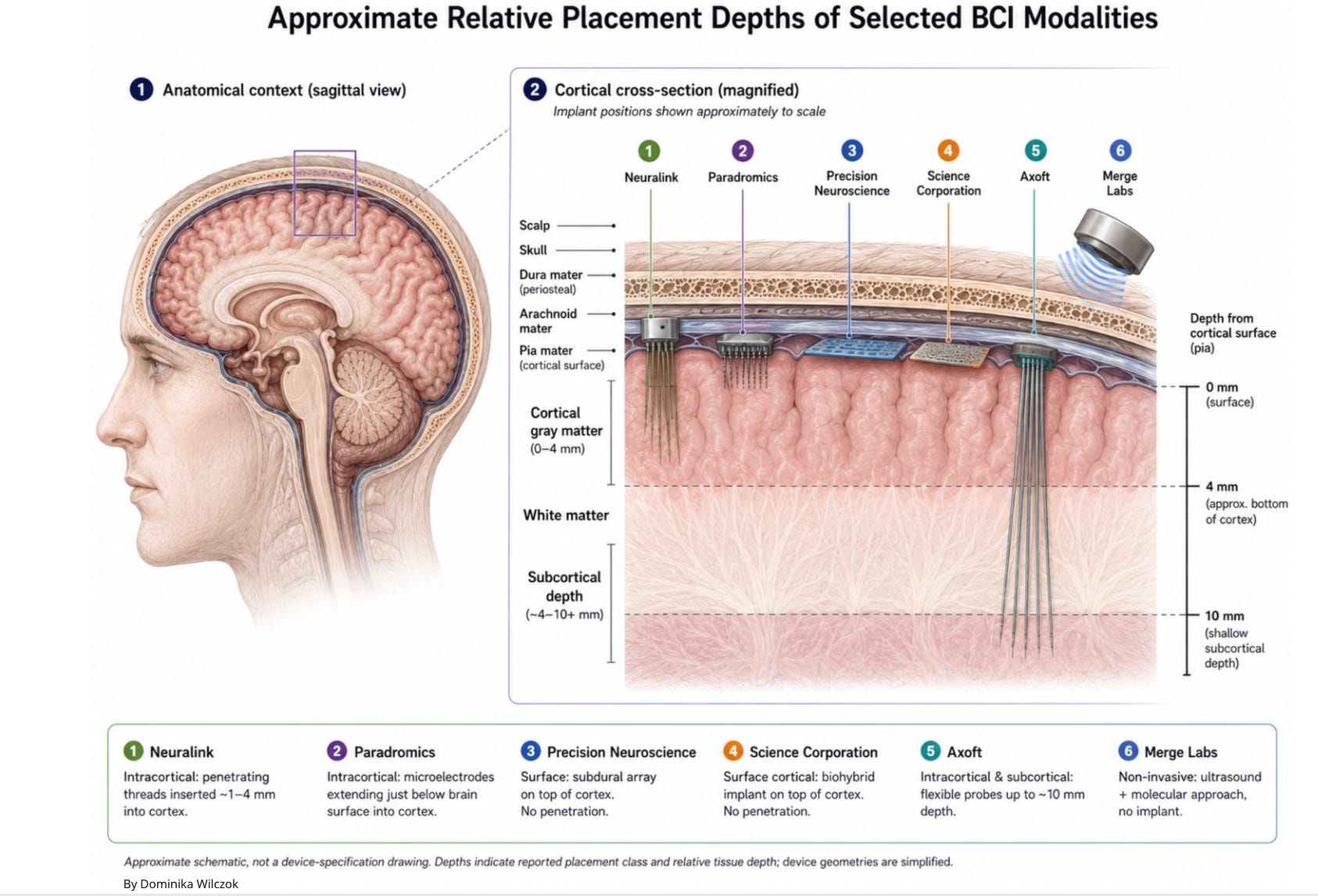
Neuralink, Paradromics, and Axoft are intracortical BCIs. They enter brain tissue to access higher-resolution neural activity. Paradromics’s BCI goes just below the surface. Neuralink is inserted roughly 1–4 mm into the cortex, close enough to record from individual neurons. Axoft pushes the depth thesis further to ~10mm to reach cortical and potentially shallow subcortical tissue. The purpose of this deeper access is bandwidth: better decoding of motor intent, communication, cursor control, robotic-limb control, and other forms of functional restoration in patients The trade-off is biological cost. Penetrating the cortex can improve signal quality, but it also increases surgical complexity, tissue response, inflammation risk, and the difficulty of maintaining stable recordings over years.
Precision Neuroscience and Science Corporation are surface-based BCIs. Their devices sit on top of the cortex, typically in the subdural space, without penetrating brain tissue. Precision’s Layer 7 array is a thin cortical surface interface; Science Corporation’s biohybrid sensor follows a related surface-level logic. These systems give up some single-neuron resolution but aim for lower tissue damage, easier implantation, better biocompatibility, and potentially more scalable clinical deployment. Their bet is that many early BCI applications may not need maximum bandwidth; they need enough signal with less risk.
Non-invasive BCIs such as the one ideated by Merge Labs (early R&D) are focused on building a broadly accessible brain–AI interface without conventional implanted hardware.
Neuralink – scaling human trials and next‑generation devices

Elon Musk’s Neuralink is arguable the best publically recognized BCI.
Trial expansion and next‑gen implants. A January 2026 update reported that Neuralink’s PRIME Study (the company’s brain‑computer implant trial) nearly doubled participation compared with September 2024; 21 patients were enrolled. Elon Musk announced a next‑generation implant with triple the channel count, expected later in the year. Patients with paralysis used the current device to play video games, browse the internet and move a computer cursor. Musk claimed the goal is eventually to restore full bodily function.
Production ambitions. Musk told Reuters that Neuralink plans high‑volume production of its BCI device in 2026 and aims to automate the surgical procedure. Human trials began in 2024 after the FDA lifted its clinical hold; by September 2025 twelve participants had been implanted and the company had raised $650 million.
Other advances: Neuralink has progressed on several fronts including an active robotic arm control trial (often referred to as CONVOY or similar feasibility study) allowing quadriplegic and ALS patients to use the N1 implant for precise control of assistive robotic arms to perform reaching, grasping, and everyday physical tasks. Their clinical arm is expanding in a particularly prolific manner with international trial expansion via the GB-PRIME study in the UK with multiple patients already implanted plus activity in Canada and other regions
Axoft – bio‑inspired implants and Series A financing
Axoft is the BCI company built around the softness problem. They argue that the bottleneck for chronic brain implants is mechanical mismatch: conventional electronics are far stiffer than brain tissue, which contributes to scarring, drift, and unstable signals. Its new material probes are designed to enter brain while behaving more like the tissue around them, combining high-density recording/stimulation with a softer, more biocompatible interface. That makes Axoft a “deep access, lower damage” bet: it wants the signal advantages of intracortical implantation without the long-term biological penalty that has historically made penetrating BCIs hard to scale.

$55 million Series A (April 29 2026). Axoft, a U.S. neurotechnology startup, raised an oversubscribed $55 million Series A to expand global clinical trials and build a GMP facility.
Novel material – Fleuron™. Axoft’s implantable BCI uses Fleuron™, a bio‑inspired material that is 10,000× softer than polyimide and provides 8× more region access and 32× more sensors per thread than conventional probes.
Clinical progress. The company has implanted its iBCIs in more than 11 patients, recording neural activity through different cortical and subcortical layers. Axoft intends to expand clinical trials globally and commercialize the material for other biomedical applications.
Paradromics – APEX Partnership
Paradromics is the oldest out of the main BCI players. Paradromics is basically Neuralink’s less-funded, less-flashy, more speech-obsessed cousin. Not tested in humans yet for chronic results (tested for acure readout - 10 min implantation and removal).

Clinical trial preparation and site expansion: Recruitment opened at key sites (including University of Michigan and Massachusetts General Hospital). The Connect-One study advanced with IRB approvals and site activations for long-term implants focused on safety, speech decoding, and computer control for patients with ALS, stroke, or spinal cord injury.
Academic partnership program. On 17 March 2026, Paradromics launched the APEX Partnership Program to connect academic researchers with its Connexus brain–computer interface. The Connexus system reportedly transfers >200 bits per second—comparable to human typing—and is already in a first‑in‑human study. Collaborators include Stanford University, Massachusetts General Hospital, the University of Pittsburgh, the University of Michigan and UC Davis. In my opinion, paradromics’ decision to open its platform to academics mirrors GPU cloud providers inviting developers early. The company aims to build an ecosystem of applications before commercialization, and scouts for young talent. VC interest should track whether these partnerships convert into licensing or co‑development agreements.
✨Random notes: If you are thinking of starting a company, do your research and name it in the way that is not dangerously simmilar to other companies in the similar industry (here broader biomed). I keep confusing Paradromics with Paragonix for organ storage.✨
Precision Neuroscience – partnerships and AI leadership

Precision, founded by Neuralik co-founder Benjamin Rapoport, positions itself as an AI‑first BCI company. They have one of the largest high-resolution human neural datasets in the industry and are actively building neural foundation models and advanced machine learning pipelines on top of this data. Their core strategy is to use AI to turn raw high-resolution cortical recordings into reliable, real-time decoding (speech, movement intent, etc.). They emphasize building robust AI systems that can generalize across patients rather than relying purely on hardware advantages.
Integration with Medtronic (January 12 2026). Precision Neuroscience announced that its Layer 7 cortical surface implant would be integrated with Medtronic’s StealthStation navigation system. The collaboration combines real‑time electrode data with surgical navigation and marks one of the first major device‑company partnerships in BCI.
Chief AI and Data Officer hire (April 8 2026). Precision brought on Craig Mermel, formerly of Google, as Chief AI & Data Officer to oversee neural‑data pipelines and machine‑learning strategy. The company noted that its Layer 7 implant has been tested in over 75 patients and has amassed a sizable neural dataset.
Partnership with UChicago Medicine (April 30 2026). Precision partnered with UChicago Medicine to study AI‑driven sensorimotor function and develop neuroprosthetic applications. The Layer 7 microelectrode array captures high‑resolution neural activity and has 510(k) clearance for up to 30 days of continuous recording. The company highlighted that it has raised $180 million and continues to build a clinical evidence base.
Science Corporation – financing and biohybrid BCIs
Founded by Max Hodak (co-founder of Neuralink), Science Corporation is positioning itself as the anti‑Neuralink pursuing retinal and surface implants rather than deep brain probes. For their BCI, they use optogenetics, which is an estabished neuroscientific method to modulate neuronal behavior through light and genetically modified cells. Instead of soft threads that just sense neurons’ signals, they genetically engineer living neurons to express light-sensitive proteins. These modified neurons are embedded in a surface implant and can be precisely activated or inhibited using light from integrated micro-LEDs. This allows the device to both record neural activity and stimulate the brain through biological intermediaries rather than direct electrical stimulation.

$230 million Series C (March 5 2026). Science Corp closed a $230 million Series C round to commercialize its PRIMA retinal implant and expand into other vision disorders. In an early trial, 80 % of patients regained functional central vision.
Executive hire (March 31 2026). Neurosurgeon Murat Günel joined as medical director for BCIs, overseeing surgical programs for a planned biohybrid implant that uses living neurons.
Partnership with Neurosoft Bioelectronics (Feb 20 2026). Science partnered with Neurosoft to provide its full BCI ecosystem to other developers, reducing the cost of building a platform from $75–100 million to under $5 million. The collaboration aims for soft, high‑bandwidth implants that cover the full cortex.
Preparing first human trial (April 14 2026). TechCrunch reported that Science Corporation is preparing the first human trial for its 520‑electrode biohybrid sensor, which sits on top of the cortex and may avoid penetrating tissue.
Neurosoft Bioelectronics – soft, stretchable electrodes and seed round
Neurosoft’s seed round underscores growing interest in soft materials for BCIs. The ability to record large-scale cortical activity without damaging tissue could be transformative. Early human data and partnerships (e.g., with Science Corp) will be key indicators.

$7.5 million seed round (May 20 2026). Neurosoft Bioelectronics raised $7.5 million to advance its soft, stretchable brain interface platform. The electrodes are up to 1,000× more compliant than conventional materials, cover 30× more cortex, and enable full cortical access without penetrating tissue. The technology has been tested in 10 patients across two trials, and the company plans to build a neural data foundation model and has more than 25 patents.
Merge Labs (OpenAI‑backed) – non‑invasive molecular/ultrasound approach
As of May 2026, Merge labs is in the realy research stage, without any hints of a proof of concept. It is pursuing a broader BCI based on non-invasive ultrasound, molecular tools (not specified), and AI decoding. The idea is to avoid the central trade-off of implanted BCIs, where better signal usually requires putting hardware into or onto the brain. Time will tell. Sam Altman has a record of backing companies at the frontier of innovation, such as Retro Biosciences in aging research, which has one drug in phase 1 clinical trials.

Seed funding led by OpenAI (Jan 15 2026). OpenAI and partners invested $250 million in Sam Altman’s Merge Labs, valuing the company at $850 million.
🇨🇳CHINA🇨🇳
China’s BCI acceleration in 2026 did not emerge spontaneously from startups alone. It followed a formal national industrial strategy released in August 2025: the Implementation Plan for Promoting Innovation and Development of the Brain-Computer Interface Industry (关于推动脑机接口产业创新发展的实施意见) naming BCI development as strategic industrial infrastructure. The plan explicitly called for major technological breakthroughs by 2027, establishment of national technical standards, construction of a domestic BCI industrial chain by 2030, and the emergence of 2–3 globally leading Chinese BCI companies.
The document outlined a 17-point implementation framework spanning implantable chips, flexible electrodes, neural signal acquisition hardware, decoding algorithms, neurosurgical systems, manufacturing capacity, clinical translation, rehabilitation applications, and commercialization pathways. Importantly, it also emphasized integration between hospitals, universities, manufacturers, and regulators — a structure that allows China to compress the distance between laboratory prototypes and scaled clinical deployment. Provincial governments eg. Jiangxi subsequently began establishing dedicated neurotechnology industrial zones and funding programs linked directly to the national roadmap.
This strategy became even more consequential in March 2026, when BCIs were incorporated into China’s 15th Five-Year Plan (2026–2030) as an official “future industry” alongside embodied AI, quantum technology, 6G communications, and fusion energy. In Chinese industrial policy language, that designation matters enormously. It signals long-term state prioritization across financing, infrastructure, regulation, talent recruitment, procurement, and manufacturing support. By the first half of 2026, companies such as NeuroXess, Neuracle and StairMed had become components of a coordinated national effort to industrialize BCIs at scale. So what’s the most recent news?
NeuroXess
NeuroXess (脑虎科技), founded in Shanghai in 2021, is one of China’s leading invasive brain–computer interface companies and has emerged as a flagship player in the country’s national BCI strategy. Unlike Neuralink’s deeply penetrating intracortical threads, NeuroXess primarily focuses on ultra-flexible polyimide-based cortical electrodes designed to reduce tissue damage, inflammation, and long-term mechanical mismatch with the brain while maintaining high-resolution neural recording capabilities. The company develops a vertically integrated “full-stack” platform spanning implantable electrodes, wireless neural signal acquisition hardware, decoding algorithms, and implantation systems. NeuroXess has publicly demonstrated a 256-channel fully implantable wireless BCI system capable of cursor control, robotic interaction, and Mandarin speech decoding, reporting motor decoding speeds of 5.2 bits per second and approximately 71.5% accuracy for direct Mandarin neural decoding
Super Factory (January 2026) NeuroXess reportedly launched a large-scale BCI manufacturing project (“super factory”) in Nanchang, Jiangxi Province, aimed at scaling implantable BCI production beyond research quantities.
Clinical Report (February 22, 2026) TechCrunch reported that NeuroXess had completed more than 50 flexible implantable BCI clinical procedures by mid-2025, making it one of the most clinically active invasive BCI groups discussed publicly in China.
StairMed
StairMed (阶梯医疗), founded in Shanghai in 2021 (see the pattern?) has positioned itself as a direct competitor to Neuralink in minimally invasive implantable brain–machine interfaces. The company develops a vertically integrated platform spanning ultra-flexible neural electrodes, wireless implant systems, decoding algorithms, and proprietary surgical robotics. StairMed’s core technological differentiator is its extremely thin flexible electrode architecture (reportedly as small as one-hundredth the width of a human hair and significantly softer than Neuralink’s.

$72.8 million financing (April 2 2026). Shanghai‑based StairMed closed a strategic round worth RMB 500 million (~$72.8 million) led by Alibaba, with participation from Tencent, OrbiMed, Fountainbridge Capital and others. The round marks a rare joint investment by Alibaba and Tencent, underscoring strategic importance.
Technology and clinical roadmap (March 2026). The company has received access to China’s NMPA Green Channel for innovative medical devices. There is information their proprietary surgical robot is operational and they plan to implant their 256‑channel wireless invasive BCI (WRS02) (Neuralink has 1,024 channels) in 40 people by the end of this year. Chinese media called it the first BCI clinical trial in china, but i didn’t manage to find any registered trial information, so let’s stay cautious. Nevertheless, they are cleared for an accelerated approval path
There are news that they are expanding their indication into closed-loop neuromodulation systems for Parkinson’s disease and epilepsy.
Neuracle – first commercial BCI approval in China
This company made headlines all over the world for becoming world’s first commerically available invasive BCI. Neuracle’s approval demonstrates regulatory momentum in China. This could catalyze adoption and attract capital to domestic players.

Regulatory approval (March 13 2026). According to reports compiled by MassDevice, China’s National Medical Products Administration (NMPA) granted Neuracle the country’s first approval for a commercial implantable BCI. The coin‑sized wireless device sits on the brain’s surface and is designed to restore hand function in patients with spinal cord injuries.
Market implications. The approval marks the first time an invasive BCI can be sold in China for clinical use. It highlights China’s ambition to compete with Western BCI firms and may create a domestic pathway distinct from U.S. FDA requirements.
Gestala – ultrasound‑based non‑invasive BCI
Gestala (格式塔科技), founded in Chengdu in January 2026, is China’s first company dedicated specifically to ultrasound-based brain–computer interfaces. The company was cofounded by Phoenix Peng, former executive at NeuroXess, together with billionaire entrepreneur Tianqiao Chen, founder of Shanda Interactive and the $1 billion Tianqiao and Chrissy Chen Institute neuroscience initiative. To my understanding, their tech idea is the same in principle as Merge Labs, discussed earlier. The company initially targets chronic pain, stroke rehabilitation, PTSD, depression, and other neurological disorders using benchtop ultrasound systems before transitioning toward wearable consumer-grade neurotechnology. They aim to complete their MVP by the end of the year.

$21.6 million seed round (March 11 2026). Two months after launch, Gestala raised $21.6 million at a valuation between $100–200 million. The round was co‑led by Guosheng Capital and Dalton Venture; commitments totaled more than $58 million.
Impressive Advisory Board: During the first half of 2026, the company rapidly assembled an unusually high-profile scientific advisory network, including former Neuralink clinical partnerships lead Bashar Badran, Cambridge neuroscientist Trevor Robbins, and Fudan University brain scientist Jianfeng Feng.
Robotics partnership (January 2026). Gestala signed a strategic partnership with Chinese robotics company Fourier, positioning ultrasound BCIs alongside embodied AI and rehabilitation robotics.
Cross Pacific Market and Investment Trends
Capital inflows. The first half of 2026 saw several nine‑figure rounds (Science Corp $230 M Series C, Axoft $55 M Series A, OpenAI‑backed Merge Labs $250 M seed, Paradromics partnership program) alongside significant Chinese funding (StairMed $72.8 M, Gestala $21.6 M). Soft materials and ultrasound BCIs attracted seed funding, suggesting diversification away from rigid implants.
Material innovation. Across companies, a common theme is biocompatibility. Axoft’s Fleuron material is 10,000× softer than polyimide; Neurosoft’s electrodes are 1,000× more compliant; Science Corp’s biohybrid sensor uses living neurons; Chinese firms tout ultra‑flexible microelectrodes. These advances aim to reduce inflammation, improve signal longevity and enable high‑density recording.
Regulatory progress. While no new FDA approvals occurred, Precision Neuroscience’s 510(k) clearance for 30‑day recordings and Neuralink’s ongoing trial expansion show increasing engagement with regulators. Neuracle’s NMPA approval may spur a regulatory race.
AI‑driven data strategies. Companies like Precision Neuroscience and Merge Labs emphasize foundation models and AI pipelines; Gestala is building an “Ultrasound Brain Bank”. VC investors should evaluate data rights, privacy frameworks and the quality of neural datasets.
Competition categories: The benchmark and comparison becomes not just “brain chip vs brain chip” but “implant + surgery + decoder + indication”
Conclusion
The first half of 2026 marked a transition for BCIs from experimental prototypes to commercial‑grade platforms. Capital flowed to both invasive and non‑invasive approaches, with significant participation from big tech (OpenAI), med‑tech giants (Medtronic) and Chinese conglomerates (Alibaba, Tencent). Regulatory milestones in China and expansions of clinical trials in the U.S. set the stage for competitive dynamics that span continents. Material innovations promise better biocompatibility, while AI strategies aim to convert neural data into scalable products. For investors and analysts, due diligence should focus on the clinical evidence, regulatory pathways, manufacturing capabilities and data strategies of each company. The next inflection point will likely be the outcomes of ongoing human trials and the first demonstrations of safe, high‑bandwidth, minimally invasive BCIs.