


I just listened to a radio discussion about longevity, and I found myself genuinely frustrated. This is going to be a more emotional piece than what I usually write, but after several years working in longevity research, I find it increasingly difficult to listen to conversations in which the very purpose of the field is misunderstood.
The program had invited a journalist to discuss longevity. Not an aging researcher, not a physician practicing longevity medicine, not even a longevity influencer like Bryan Johnson. Simply someone interested in longevity, which, in itself, is perfectly fine. I strongly believe that scientific subjects should be discussed beyond scientific circles, and that people without formal scientific training should feel entitled to participate in these conversations. But participate is way differnt from posing as an expert. My frustration was not with the person being interviewed, but with how longevity was framed throughout the discussion.
The conversation revolved around exercise, healthy eating, spending time outdoors with your children, and the discipline required to maintain a healthy lifestyle. Longevity was portrayed almost as a demanding personal regime, something you impose on yourself today in the hope of being rewarded with more years in the future. At one point, the discussion turned to whether such sacrifices are even worthwhile, considering that life is unpredictable. You could be hit by a car tomorrow, or some catastrophe could prevent you from ever enjoying the benefits of your carefully optimized lifestyle.
What bothered me was not that these arguments were unreasonable, but that they were directed at a rather different concept from the one that longevity researchers are working toward.
We have made longevity mean almost everything
Longevity has a naming problem, and we have known this for a while. The term has expanded to encompass fitness, nutrition, supplements, preventive medicine, biological age testing, regenerative medicine, and experimental interventions designed to modify fundamental mechanisms of aging. A company selling nutritional supplements and a laboratory developing cellular reprogramming therapies can both describe themselves as working in longevity, even though their scientific objectives, methods, and evidence are radically different. This ambiguity is no longer merely semantic. It shapes public expectations, influences investment decisions, and makes it increasingly difficult to distinguish established preventive medicine from experimental attempts to alter the biology of aging.
Richard Miller, a scientist I greatly respect and with whom I have had the privilege of co-authoring research, recently published Seven ways not to think carefully about aging, challenging several assumptions that have become commonplace even within biogerontology. His criticism is especially relevant because confusion about what constitutes aging, how we measure it, and what it would mean to modify it exists within the scientific community itself. We cannot reasonably expect the public to distinguish between different longevity interventions if we fail to define their objectives clearly.
I would argue that one of the most important distinctions is between optimizing your health today and modifying the biological trajectory of your future health. Health optimization aims to improve your current condition, whether through exercise, better nutrition, sleep, or treatment of existing risk factors.
Longevity biotechnology has a different ambition: developing interventions that prevent, delay, or reverse the deterioration of physiological and cognitive function associated with advancing age.
The two objectives overlap, and many lifestyle interventions have substantial long-term benefits, but they should not be treated as interchangeable.
Consider the difference between improving your cardiorespiratory fitness at 30 and developing a therapy that allows you to maintain that same physiological capacity at 80. The first is a well-established and achievable objective. The second is a considerably more ambitious biomedical challenge. We have extensive evidence supporting the benefits of physical activity, including its contribution to healthier aging, but no lifestyle intervention has been demonstrated to eliminate the progressive biological changes associated with human aging.
This is the distinction that was almost entirely absent from the radio discussion. Longevity was reduced to a set of behaviors that might make someone healthier today, rather than presented as an effort to change the extent to which advancing age compromises human function. What was totally ommited is that no matter how “healthy” lifestyle one lives now, we don’t have ANY evidence that it will prevent age-related decline. Let alone add years to life (excluding disease-adjusted curves).
Why invest in a future that is not guaranteed?
One argument from the discussion particularly stayed with me: why impose restrictions on yourself today when there is no guarantee that you will live long enough to benefit from them? You could die in a traffic accident tomorrow, so perhaps it is better to enjoy life rather than constantly prepare for an uncertain future.
I find this reasoning peculiar because almost every major investment we make in life operates under precisely the same uncertainty. Education is probably the clearest example. We invest years of effort and substantial financial resources into educating children without any guarantee that they will live long enough to benefit from that education. Would you withdraw your child from primary school because there is a possibility that they might die before university? Presumably not. We recognize that the possibility of an unforeseen event does not invalidate an investment intended to expand future opportunities. The same logic applies to building a career, saving for retirement, or acquiring skills that may only become valuable decades later.
Of course, there is a meaningful difference between investments in education and those in longevity. Education provides capabilities that we know how to develop, whereas many of the biomedical interventions we hope will modify aging have yet to demonstrate clinical efficacy. This uncertainty should influence how we evaluate claims and allocate resources, but it should not make the underlying ambition irrational. The possibility that an individual may not benefit from a future medical breakthrough is not an argument against developing that breakthrough.
More importantly, longevity should not be understood as an obligation to sacrifice the present. Exercise, nutritious food, and adequate sleep have benefits that can be experienced immediately. Nor does investing in future health necessarily imply adopting an extreme lifestyle. The question is whether we can develop technologies that allow people to retain their health and abilities without requiring an increasingly demanding effort to compensate for biological decline.
What are we actually trying to preserve?
When longevity enters mainstream discussion, the conversation often begins and ends with how many years people would like to live. I think this framing misses something fundamental: our objective should not simply be to accumulate more years, but to preserve the capabilities that allow us to make meaningful use of those years. At the same time, I would like to clearly state that the common argument used to refute longevity efforts “We don’t want interventions that increase lifespan, without increasing healthspan” totally misses the point. Unless it talks about putting a person in the comma and sustaining life via a respirator and IV nutrition, I can’t name a single intervention, let alone a geroscience-derived one, that would not improve health while it potentially elongates lifespan (excluding disease cases e.g. in oncology).
Consider Warren Buffett. He has accumulated decades of extraordinary experience, knowledge, and judgment, yet, like everyone else, he is subject to the biological consequences of advancing age. Imagine if an individual could accumulate that same experience while retaining the physiological reserve, mobility, and cognitive processing capabilities of their younger self. The interesting possibility is not merely that such a person might live longer, but that the years of accumulated knowledge would no longer have to coincide with progressive limitations in the biological systems through which that knowledge is applied.
An even more immediate example is our parents and grandparents. Think about activities they could perform effortlessly twenty or thirty years ago that now require greater effort, more recovery time, or are no longer possible. Many older adults remain remarkably active and intellectually engaged, and not every domain of cognition deteriorates with age. Nevertheless, declines in muscular strength, aerobic capacity, immune responsiveness, and certain cognitive functions are well documented. Importantly, these changes do not begin when a person is diagnosed with an age-related disease. They can accumulate gradually over decades, often while the individual is still considered clinically healthy.
This is closely related to the concept of Peakspan, which I explored in a paper with Alex Zhavoronkov and Kejun Ying. We proposed defining Peakspan as the period during which an individual maintains at least 90% of their peak performance in a given physiological or cognitive domain. Unlike healthspan, which is commonly understood in terms of years lived without significant disease or disability, Peakspan addresses the functional decline that can occur well before conventional thresholds of disease are reached.
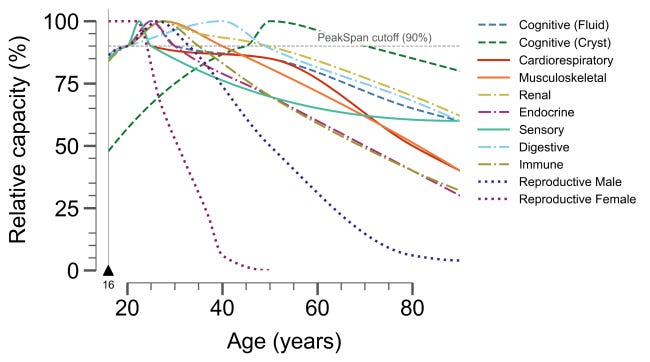
A person might have no diagnosed cardiovascular disease yet possess only a fraction of their earlier maximal aerobic capacity. Another might remain cognitively healthy according to clinical screening while experiencing measurable changes in processing speed. These changes are not necessarily pathological in the conventional sense, but they can progressively narrow the range of activities available to an individual. Consequently, living without a diagnosed disease is not equivalent to retaining the capabilities one had earlier in life.
This is precisely where I see one of the greatest opportunities for longevity research. If we could delay the point at which physiological systems begin to lose substantial functional capacity, or restore capacities that have already declined, we could change the experience of aging even without dramatically extending maximum lifespan. And if such interventions eventually also extend life, the additional years could become substantially more valuable because they would be accompanied by preserved function.
Longevity Biotech vs Anti-Ageism Social Movement
My argument is not that older individuals become less valuable as their physical or cognitive capabilities decline. Quite the opposite, and I believe my personal experience gives me some grounds to speak on this. Years before I became involved in longevity research, I founded an NGO in Poland that worked to counter ageism and the social exclusion of older people. I have experienced ageism from the younger end myself, being told, directly or indirectly, that I was too young to have an opinion worth considering. At the other end, I have witnessed the experiences of older family members and friends who were increasingly treated as though their opinions, ambitions, and contributions mattered less simply because of their age. These are different manifestations of the same prejudice: the assumption that someone’s age determines the value of what they have to offer.
For years, I approached this primarily as a social problem, something that could be addressed through education, advocacy, and changing public attitudes. However, as I gained a deeper understanding of aging biology, and perhaps simply more life experience, my perspective began to change. I came to realize that while campaigns against ageism are necessary, no number of slogans can eliminate the biological decline that often underlies some of the practical disadvantages experienced by older people. Loss of mobility, strength, sensory function, or cognitive capacity can progressively restrict independence, employment opportunities, and participation in activities that were previously effortless. These limitations can then become the basis for exclusion, or be used to justify prejudices that extend far beyond an individual’s actual capabilities.
Of course, biological decline does not justify discrimination, and respect for an individual should never depend on their physical performance, productivity, or independence. That should be beyond debate. But I have increasingly come to believe that one of the most powerful ways to fight the consequences of ageism is to address the biology of aging itself. We should continue challenging the social attitudes that marginalize older people, while also developing interventions that allow them to retain the capabilities and autonomy that society too often assumes they have lost. If we can prevent or substantially delay functional decline, we can remove one of the conditions that makes age-based exclusion so pervasive. To me, longevity research has therefore become an extension of the advocacy work I started years ago: rather than only asking society to stop treating older people as less capable, I want science to help ensure that advancing age does not have to mean becoming less capable in the first place.
And this brings me to something I find equally difficult to understand: the reluctance to engage with preventive medicine, even when the interventions are already available, affordable, and supported by substantial clinical evidence. I am not talking about expensive biological age tests, experimental geroprotectors, or elaborate optimization protocols. I mean ordinary, evidence-based preventive care: attending age-appropriate cancer screenings, monitoring cardiovascular risk factors, following recommended vaccination schedules, and investigating symptoms before a treatable condition progresses into something much more serious. Many of these services are publicly funded or relatively inexpensive in numerous healthcare systems, although access remains far from universal. To me, neglecting them when they are readily accessible is difficult to reconcile with how we approach almost any other aspect of our health. Imagine breaking your leg and deciding not to see a doctor because the bone might eventually heal on its own. It might, but without appropriate assessment and treatment, you could be left with a poorly healed fracture and avoidable long-term disability. Most people would recognize the value of seeking professional care rather than accepting that risk. Why, then, are we sometimes so reluctant to apply similar reasoning to conditions that develop silently over years?
And what about living beyond the current human limit?
There is another dimension of longevity that receives surprisingly little serious attention in mainstream conversations, despite being one of the field’s most ambitious objectives: the possibility of extending human lifespan beyond what has ever been observed.
The longest verified human lifespan remains Jeanne Calment’s 122 years and 164 days (some debate the validity of her birth certificate, though). Whether this record reflects a fundamental biological limit or simply the longest life observed within the constraints of human biology and historical medicine remains unresolved. No currently available intervention has been shown to extend human life beyond this record, and we are still far from demonstrating that the maximum human lifespan can be substantially increased.
Nevertheless, this is a legitimate scientific question. Advances in regenerative medicine, cellular reprogramming, immune rejuvenation, and organ replacement could eventually allow us to address forms of damage or dysfunction that currently limit survival. Some interventions may prove capable of preserving function without extending maximum lifespan, while others might affect both. Replacement technologies, for example, could compensate for the failure of individual organs without necessarily reversing systemic aging. Whether such approaches can be combined into something resembling comprehensive biological rejuvenation remains unknown.
I think it is important to distinguish this ambition from more immediate efforts to prevent age-related disease and functional decline. Developing a therapy that preserves muscle function in older adults, delaying the onset of Alzheimer’s disease, and extending maximum human lifespan are related but scientifically distinct objectives. They require different experimental approaches, clinical endpoints, and levels of evidence. Lumping them together under one vaguely defined label makes it easier to advertise longevity, but considerably harder to assess what progress has actually been made.
Perhaps the problem is how we talk about getting older
I do not think everyone needs to aspire to live to 120, 150, or 200. Some people may be interested in extreme lifespan extension, while others would simply like to remain independent and physically capable for as long as possible. Both are legitimate preferences, and neither should be imposed on anyone. I also reject the idea that longevity requires a life of permanent self-denial, where every meal, social activity, or moment of rest must be justified against its possible effects on future biological age.
What troubles me is how readily we accept age-related deterioration as something that should simply be accommodated, rather than investigated as a collection of biological processes that may eventually become medically modifiable. We have no difficulty recognizing the value of restoring sight, replacing failing joints, or treating diseases that would once have been fatal. Yet the gradual decline of multiple physiological systems with advancing age is still frequently treated as an inevitable fact of life, rather than a potential target for intervention. Some components of aging may indeed prove much harder to modify than others, but we cannot establish those limits without attempting to understand and test them.
I would like the public conversation about longevity to reflect this distinction more clearly. It should be possible to enjoy your life today, exercise because it makes you feel good, spend time with your children, and make sensible choices about your health, while also supporting scientific efforts to change what growing older will mean for future generations. These ideas are not in conflict. One addresses how we live within the biological constraints we currently have; the other asks whether those constraints can be changed.
If longevity is going to remain the word we use for both, we owe it to the public to explain the difference.
Because what interests me about longevity is not the prospect of spending another decade following a meticulously optimized routine. It is the possibility that, one day, we might no longer have to accept a gradual loss of physical and cognitive ability as the inevitable price of accumulating years of experience.
And that is a scientific objective worth distinguishing from simply living a healthy lifestyle.
The distinction between improving health today and changing the biological trajectory is overdue, and Peakspan names something clinicians see constantly: function narrowing years before any diagnostic threshold is crossed. Living without a diagnosis is not the same as keeping your capacity. One nuance I'd add: some of that early loss is measurable now, not only in VO2 max or processing speed but in autonomic markers like recovery capacity and heart rate variability, which tend to drift well before disease does. That doesn't make stress management geroscience. But it could be a useful early readout while the harder biomedical work catches up.
💯 totally agree
But how do we radicalize (aka allow thinking and talking about more ambitious goals) more people?