


The 20 finalists reveal a field split between two competing models of longevity medicine:
High-technology rejuvenation therapeutics—cell therapies, engineered extracellular vesicles, gene delivery, mitochondrial drugs, targeted biologics and protein degraders.
Deployable multidomain programs—combinations of existing drugs, supplements, nutrition, exercise and personalized digital care.
The $1 million Milestone 2 awards strongly favored the first group. At least 6 of the 10 awardees are advanced therapeutic platforms, compared with only approximately 1–2 of the 10 non-awarded finalists. However, the finalist cohort as a whole contains more combination programs than any single therapeutic modality.
1. Judging criteria
Teams were scored from 1 (best) to 9 (worst) across six core criteria:
Team: Relevant scientific and clinical-trial experience, complementary expertise, effective governance, and capabilities in study coordination, biostatistics, data management, and measurement of muscle, cognitive and immune function.
Clinical center: Availability of qualified staff, equipment and laboratory infrastructure; access to participants; ability to recruit and retain them; and capacity to follow common protocols and transmit high-quality data securely.
Scalability and accessibility: Whether the intervention could reach a large population, considering manufacturing and delivery constraints, stability, treatment burden, safety and quality-control risks, and affordability.
Scientific rationale: The rigor of the underlying research and whether the proposed mechanism and intervention were supported by credible preclinical, clinical or published evidence.
Preliminary human data: Quality of proof-of-concept results, including safety, adherence, recruitment, data integrity, relevant biomarkers, and evidence of effects across multiple physiological systems.
Finals testing approach: Feasibility of the proposed one-year trial, including population selection, sample size, dosing, controls, randomization, blinding, recruitment and retention, product availability, safety monitoring, timelines and contingency plans.
Safety, human-subject protections, regulatory readiness and sufficient funding were additionally assessed as acceptable or unacceptable. Judges then assigned a weighted overall score reflecting the likelihood that each intervention could improve muscle, cognitive and immune function; the ten highest-ranked teams received $1 million and automatic advancement. XPRIZE did not publish the final weights, cut-off scores or individual scorecards. Source: XPRIZE Healthspan Finals Application Guidelines
2. Who was selected—and who actually received money?
XPRIZE announced 20 finalists on August 11, 2026. All 20 advance toward the clinical-trial phase, but only 10 received a Milestone 2 award.
Each Milestone 2 awardee receives:
$1 million
Access to centralized clinical-testing resources
Trial coordination through the University of Utah Data Coordinating Center
Central laboratory, biomarker and biorepository support coordinated by UC San Diego
The final prize—up to $81 million—is expected in 2030. Finalists must attempt to restore muscle, cognitive and immune function by the equivalent of at least 10 years, ideally 20, in adults aged 50–90, within no more than one year of treatment. XPRIZE’s official announcement
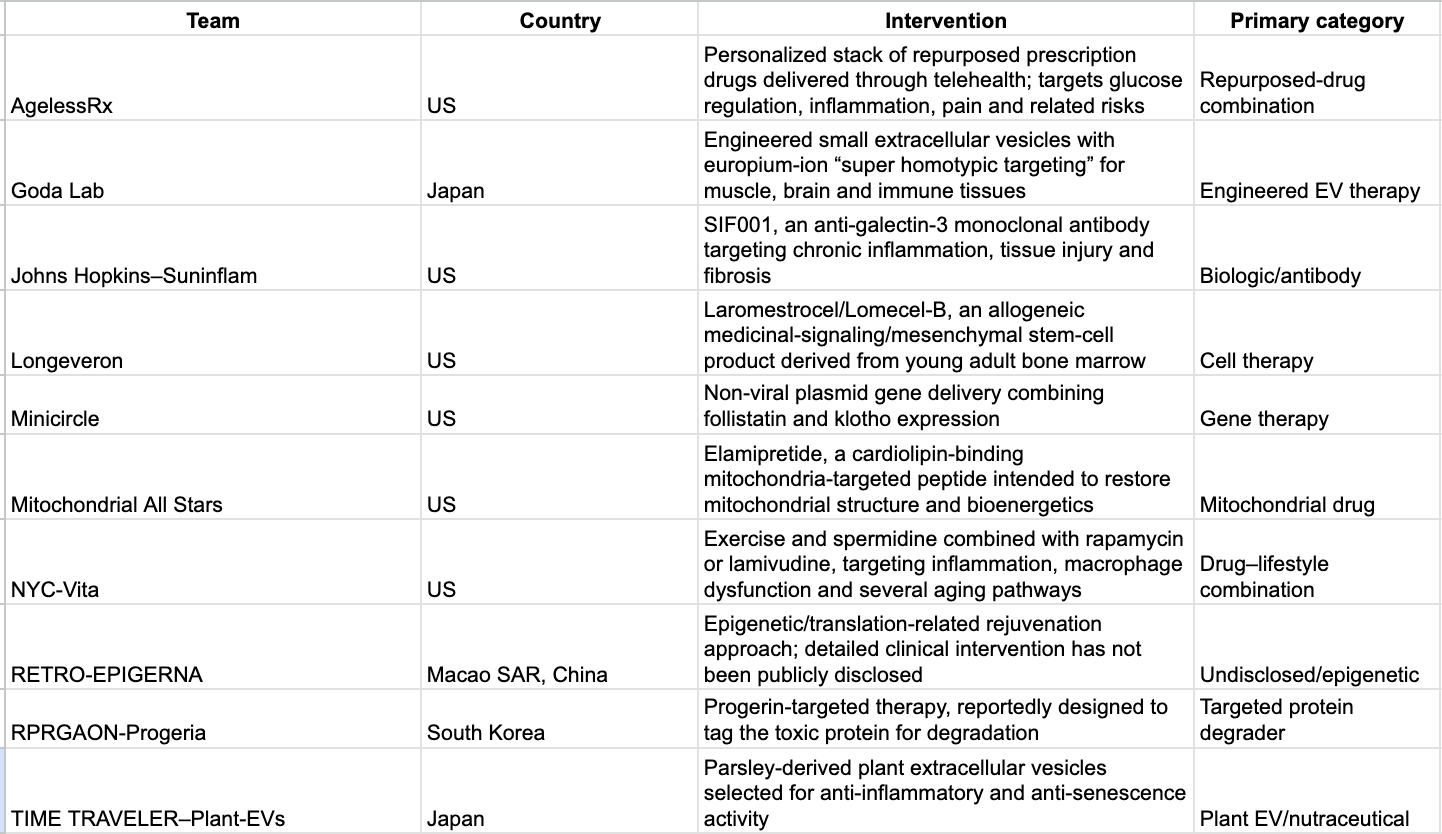
Milestone 2 awardees: $1 million each
Finalists advancing without a Milestone 2 cash award
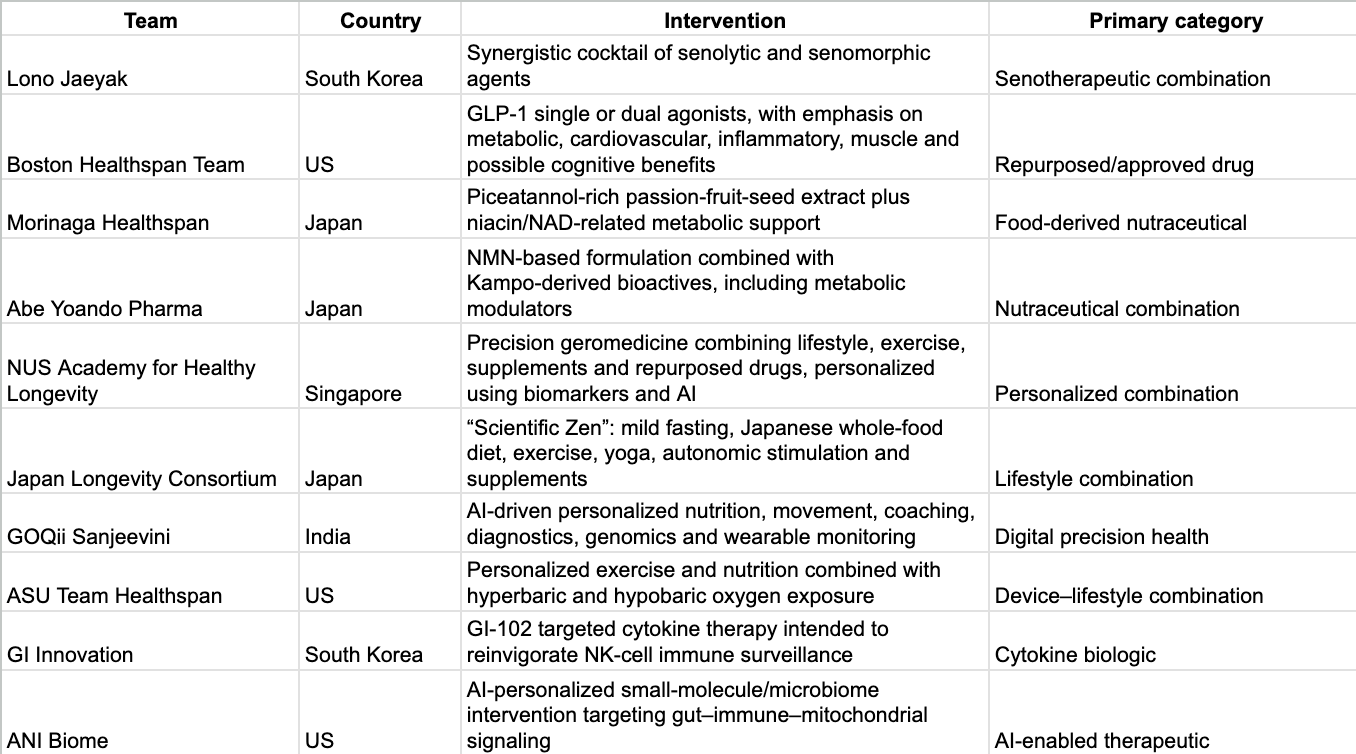
The official list of all 20 finalists was reported by XPRIZE and independently summarized by Longevity.Technology.
2. Quantitative analysis
The awards favored advanced biotech
The awardees include:
A monoclonal antibody
A stem-cell product
A plasmid gene therapy
A mitochondrial peptide
A targeted progerin degrader
An engineered EV system
A plant-EV intervention
Two drug or drug–lifestyle combinations
One undisclosed epigenetic program
By contrast, most of the non-awarded finalists rely on:
Exercise and dietary programs
Existing prescription drugs
Supplements or food-derived compounds
AI personalization
Wearables and behavioral coaching
A lifestyle program may be easier to scale, but a targeted biologic or regenerative therapy may be judged more likely to generate the very large functional effect required by the prize.
4. Geographic trend
Asia: 11 finalists, 55%
United States: 9 finalists, 45%
Europe: 0
Canada: 0
Australia: 0
Latin America, Middle East and Africa: 0
This is striking because the 2025 semifinalist pool contained teams from Europe, Canada, Australia and other regions. None survived into the final 20.
The competitive center of translational longevity has shifted toward an American–East Asian axis. Japan is particularly overrepresented: one-quarter of all finalists come from Japan, despite the country’s smaller biotechnology investment base relative to the US (Longevity Education Hub offers the free, CME accredited course in healthy longevity medicine in japanese!).
5. Dominant biological trend: inflammaging
Inflammation and immune decline are the closest thing to a consensus mechanism in the finalist cohort.
Even teams nominally focused on mitochondria, metabolism, stem cells, exercise or the microbiome usually claim downstream effects on:
Chronic low-grade inflammation
NK- and T-cell competence
Senescent-cell clearance
Macrophage function
Tissue repair
Fibrotic signaling
This likely reflects the design of the competition: every finalist must improve immune function as well as muscle and cognition. Inflammation provides a plausible mechanistic bridge connecting all three.
6. Other major trends
A. Repurposing is highly competitive
Several finalists avoid the conventional decade-long drug-development pathway:
Rapamycin
Lamivudine
GLP-1 agonists
Elamipretide, already extensively tested clinically
An antibody repurposed toward inflammaging
XPRIZE’s one-year treatment window and accessibility requirements naturally reward therapies with known safety, manufacturing and human-exposure data.
B. Reprogramming is underrepresented, contrary to the funding hype
The awarded group includes cells, EVs and gene delivery. However, there is no clearly disclosed, conventional OSK/OSKM partial-reprogramming therapy among the finalists. RETRO-EPIGERNA may involve epigenetic regulation, but its intervention remains undisclosed. The visible finalists generally favor:
Repairing damaged tissue
Improving mitochondrial function
Modifying circulating signals
Removing toxic proteins
Restoring immune surveillance
rather than directly resetting cell identity.
That suggests XPRIZE selection currently rewards translational readiness over maximal theoretical rejuvenation.
C. EVs have emerged as a real therapeutic category
Two awardees are EV-based:
Goda Lab’s engineered mammalian small EVs
TIME TRAVELER’s edible plant-derived EVs
This is notable because they sit at opposite ends of the development spectrum:
Goda offers targeted, engineered regenerative biotechnology.
TIME TRAVELER offers potentially inexpensive, orally deployable plant EVs.
If either succeeds, EVs could become one of the most important validated delivery or signaling platforms in longevity medicine.
D. AI is mainly used for personalization—not drug discovery
AI is present in ANI Biome, NUS comercial entity, GOQii and ASU, but primarily for individual stratification, dynamic treatment adjustment, digital phenotyping, wearable-data interpretation or multimodal biomarker integration.
The finalists do not show a strong wave of purely AI-discovered novel geroprotective drugs. AI is functioning as the control layer for combination medicine, not as the therapeutic itself.
E. Functional endpoints are displacing aging clocks
Many teams use epigenetic clocks, multi-omics or biological-age scores as secondary measures. But since the competition is ultimately structured around muscle function, cognitive performance and immune function, atreatment will not win merely by lowering a biological-age estimate. It must make older participants function measurably more like younger people.
XPRIZE is therefore testing a more demanding proposition than most commercial longevity clinics
7. Important absences
The finalist list is as revealing for what is missing as for what is present. There are no clearly visible finalists centered on:
In-vivo OSK/OSKM reprogramming
Telomerase gene therapy as the principal intervention
Plasma dilution or therapeutic plasma exchange
Organ replacement or engineered organs
Microbiome transplantation
CRISPR-based permanent genome editing
Several of these approaches were represented in the broader longevity ecosystem or earlier applicant pool. Their absence likely reflects safety, scalability, clinical readiness or difficulty demonstrating benefits across all three XPRIZE domains within one year.
8. Overall verdict
The finalists do not support the idea that the field has converged on one “best” anti-aging target. Instead, they show convergence at a higher level:
Aging must be treated systemically.
Advanced biotech is favored for funding, but scalable repurposed interventions remain competitive.
The US and East Asia now dominate translational longevity.
The eventual winner may be determined as much by trial execution and participant adherence as by mechanism.
XPRIZE finalist lists show two pathways in longevity: one with immediate gragerotherapeutic biotech seeking large biological effects and precision preventive medicine seeking broad accessibility. The clinical phase will reveal whether the prize’s extraordinarily ambitious functional target is better met by a powerful new modality or by a carefully engineered combination of interventions that already exist.