

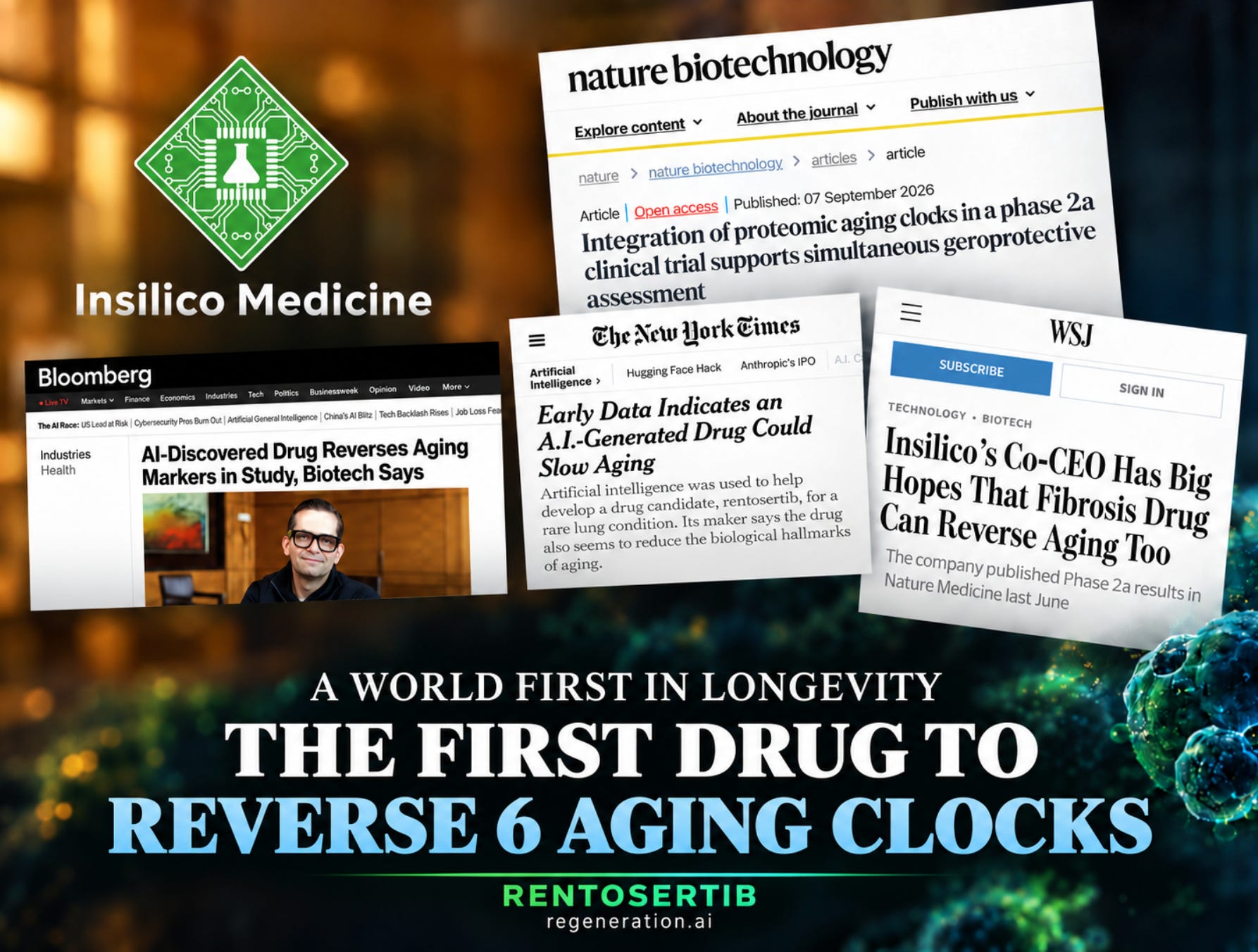
The Nature Biotechnology paper by Insilico Medicine have turned the clinical trial landscape towards longevity.
For years, longevity biotechnology has had two largely separate worlds.
In one, researchers build aging clocks, algorithms that estimate biological age, from DNA methylation, proteins or other molecular data. In the other, pharmaceutical companies run clinical trials built around conventional disease endpoints: lung function, tumor size, glucose control, cardiovascular events.
Today, those worlds moved closer together.
A study published in Nature Biotechnology by the one and only Insilico Medicine team, applied six independently developed proteomic aging clocks to blood samples from a randomized phase 2a trial of rentosertib, a drug for idiopathic pulmonary fibrosis (IPF). Every clock detected a treatment-associated shift toward a younger proteomic profile somewhere across the tested doses and timepoints. The strongest cross-clock agreement appeared after four weeks of treatment.
That is a genuine first. To the best of current evidence, rentosertib is the first de novo drug candidate selected with aging biology in mind to produce a convergent signal across six proteomic aging clocks in a randomized human trial dataset.
This is the first systematic attempt to evaluate a new, purpose-built drug with several proteomic clocks at once, then connect their predictions back to dose, mechanism, senescence and a conventional clinical endpoint. It turns aging clocks from an interesting score into part of a drug-development workflow.
Not another metformin story
Most drugs discussed as possible geroprotectors were not born as longevity drugs. Metformin began as a diabetes medicine. Rapamycin began as an immunosuppressant. Semaglutide was developed for diabetes and obesity. Researchers noticed their broader biology later and began asking whether they might also slow aspects of aging.
Rentosertib followed a different path.
Insilico Medicine used its PandaOmics platform to identify TRAF2- and NCK-interacting kinase, or TNIK, as a target connecting fibrosis with multiple hallmarks of aging. Its generative chemistry platform was then used to design a selective small-molecule TNIK inhibitor. The program moved from target discovery to a nominated preclinical candidate in roughly 18 months, according to the team’s earlier discovery-to-clinic Nature Biotech paper.
The disease chosen for development was IPF, a progressive and usually fatal scarring disorder of the lungs. IPF is not aging itself, but it is tightly age-linked and shares biology with aging: cellular senescence, chronic inflammation, altered nutrient sensing, extracellular-matrix remodeling and impaired tissue repair (read the paper on that, which I co-authored).
That makes IPF a practical regulatory doorway. Aging is not currently an approved disease indication. IPF is. A drug can therefore be developed against a recognized disease while researchers measure, in parallel, whether it also moves aging-related biology.
The original phase 2a trial randomized 71 people with IPF to placebo or one of three oral rentosertib regimens for 12 weeks: 30 mg once daily, 30 mg twice daily or 60 mg once daily. The study met its primary safety and tolerability objective. It also produced an exploratory lung-function signal: mean forced vital capacity rose by 98.4 milliliters in the 60 mg once-daily group, compared with a 20.3-milliliter decline on placebo. Again, this was the first time ever that a drug managed to reverse the effects of IPF in patients, rather than just slow the decline.
The new paper asks a different question of the same trial: did the drug make the patients’ molecular profiles look younger?
Six clocks enter the clinic
Forty-two trial participants, with a mean age of 67.1 years, had complete serum samples at baseline and at weeks 2, 4 and 12 and consented to the proteomic substudy. The researchers measured 2,841 circulating proteins with the Olink Explore 3072 platform and passed the resulting data through six clocks:
ProtAge
ipfP3GPT
PAOPAC
PAC
OrganAge trained on chronological age
OrganAge trained on mortality risk
These were not six cosmetic variations of one model. Some used traditional machine learning and others deep learning. Four were trained to estimate chronological age; two were trained against mortality. They also differed in their protein features and construction.
That diversity matters because aging clocks are notoriously capable of disagreeing. A result seen with one clock may reflect that model’s assumptions, technical noise or sensitivity to one biological pathway. Agreement among several clocks is harder to dismiss as a model-specific artifact.
Across 54 comparisons (six clocks, three treatment regimens and three post-baseline timepoints) 21 showed a statistically significant younger shift relative to placebo using the study’s exploratory false-discovery threshold of q < 0.10. At week 4 alone, 11 of 18 clock-by-regimen comparisons were significant.
The clearest single chronological-age result came from the 60 mg once-daily arm at week 4: all four chronology-trained clocks estimated a reduction of roughly 2.7 to 3.5 biological years relative to placebo. But the broadest agreement appeared with 30 mg twice daily, which was detected by both chronological and mortality-trained models. At that week-4 timepoint, five of the six clocks showed effect sizes pointing in the younger direction.
By week 12, the headline signal had not continued to deepen. It largely plateaued, and fewer comparisons remained significant. The underlying protein changes at the more active doses were mostly sustained or still developing, but the aggregate clock scores stopped falling.
What did the proteins show?
If the clocks merely registered that patients’ lungs were improving, the dose with the best lung response should also have produced the strongest “rejuvenation” signal.
It did not.
The 60 mg once-daily regimen produced the largest improvement in forced vital capacity. The 30 mg twice-daily (so 60mg in total but over time) regimen produced the most consistent multi-clock response. Across the six clocks, change in lung function explained a median of only 6% of the variation in predicted biological-age change.
The researchers then compared the trial’s protein shifts with age-associated protein trajectories in 55,319 UK Biobank participants. Proteins altered by rentosertib were enriched for proteins that normally change with age. More strikingly, changes in the 30 mg twice-daily arm ran modestly but significantly against the direction of normal aging. The 60 mg once-daily arm—again, the best one for lung function—did not show the same relationship.
Forced vital capacity captures only one dimension of IPF. Reducing systemic inflammation or metabolic dysfunction could make an aging clock read younger without changing fundamental aging biology.
It also suggests that aging biomarkers could reveal differences between dosing schedules that a standard disease endpoint misses. Rentosertib has a half-life of roughly 7–11 hours. Two 30 mg doses may maintain steadier exposure, while one 60 mg dose creates a higher peak. Equal daily milligrams do not necessarily mean equal downstream biology.
Looking beneath the clock
Proteomic clocks have one major advantage over many DNA-methylation clocks: their inputs are proteins, the molecules actually executing biological processes. Researchers can inspect which proteins changed and ask what pathways they belong to.
Rentosertib altered the trajectories of 326 proteins across the treatment arms, compared with only two in the placebo group. The changes included lower levels of proteins involved in fibrosis and extracellular-matrix remodeling, such as COL1A1, MMP10 and FAP, and higher levels of proteins involved in metabolism and stress resistance, including NAMPT, SOD2 and ALDH1A1.
The researchers also tested established senescence signatures. In the placebo group, proteins from the SenMayo panel became more abundant over time. Treated groups generally moved in the opposite direction, while a gene set associated with inhibition of senescence moved upward. Proteins including EREG, IGFBP4, MMP10, MMP13 and SPP1 repeatedly contributed to the divergence.
Beyond senescence, the 30 mg twice-daily regimen affected glutathione metabolism, cholesterol metabolism and the pentose-phosphate pathway. The analysis also pointed toward modulation of IGF signaling, growth-factor pathways and nutrient sensing—processes with long-standing connections to aging biology.
All the ways it is “the first time”
What rentosertib appears to be first at is this combination:
A new drug, rather than a lifestyle intervention or an already approved medicine repurposed after the fact.
A new target selected partly through aging biology, not merely a conventional disease target later rebranded as geroscience.
A randomized clinical-trial dataset with longitudinal sampling.
A head-to-head analysis using six independently developed proteomic clocks.
A multi-layer attempt to separate disease response from aging biology using lung function, normal-aging trajectories, senescence signatures and pathway analysis.
The authors describe this as a blueprint for a dual-purpose clinical trial: treat a specific age-related disease while simultaneously looking for evidence of broader geroprotective activity. That is the right framing.
Importance of including clocks in clinical trials
The longevity field does not mainly suffer from a shortage of molecules that improve a biomarker in mice. It suffers from a translation problem.
Waiting to learn whether a drug extends human lifespan is impossible within a normal development cycle. Even waiting for multiple diseases to appear takes years and enormous trials. Without credible intermediate endpoints, potentially valuable geroprotectors can remain invisible inside conventional drug programs.
Proteomic clocks could become one layer of that intermediate infrastructure. They might help researchers:
identify disease drugs with broader effects on aging biology;
compare regimens that look similar on the primary endpoint;
select candidates for dedicated geroscience trials;
connect a composite age signal to specific pathways and proteins; and
build evidence while remaining inside existing regulatory indications.
No clock is ready to serve as a surrogate for longer life or even longer healthspan. For that, changes in the clock must repeatedly predict later changes in function, disease and mortality—and must do so across drugs, populations and laboratories. But biomarkers do not need to be perfect or causal to be useful. They need to be reproducible, technically reliable and predictive of outcomes that matter.
Rentosertib is a valuable stress test of that proposition.
What’s next?
Rentosertib has now entered a larger phase 3 trial in China, designed to test whether its early lung-function result translates into durable clinical benefit. This is the most importants news the longevity ecosystem had since the development of the first aging clock in 2013 - today, we became a milestep closer to a real gerotherapeutic.
A small question: if a treatment changes fibrosis-related biology and several proteomic “aging clocks” move with it, how do we know that the clocks are measuring aging itself rather than a changing disease state?
Dominika, excellent article! I just watched your ARDD2025 presentation and thought it was very insightful! I'm sharing some links that I think you might find interesting.
https://youtu.be/Aj6pvAxWJyA
https://www.lifebiosciences.com/our-platform/targeting-the-biology-of-aging/
https://www.techbuzz.ai/articles/r3-bio-raises-funding-to-grow-brain-free-organ-systems
https://www.sciencefocus.com/the-human-body/freezing-brain-back-to-life