

I’ve been following emerging treatments for Alzheimer’s disease since I founded my NGO in Poland seven years ago. A lot has happened since then: the rise of blood-based biomarkers, growing challenges to the amyloid hypothesis as a complete explanation of the disease, the approval of the first two disease-modifying anti-amyloid antibodies, major advances in tau-targeted therapeutics, growing recognition of neuroinflammation and the gut–brain axis as therapeutic targets, breakthroughs in understanding the brain’s glymphatic and meningeal lymphatic systems, and the emergence of entirely new approaches—from focused ultrasound to experimental surgery aimed at restoring the brain’s natural waste-clearance mechanisms.
However, a sugery for Alzheimer’s disease never even crossed my mind.
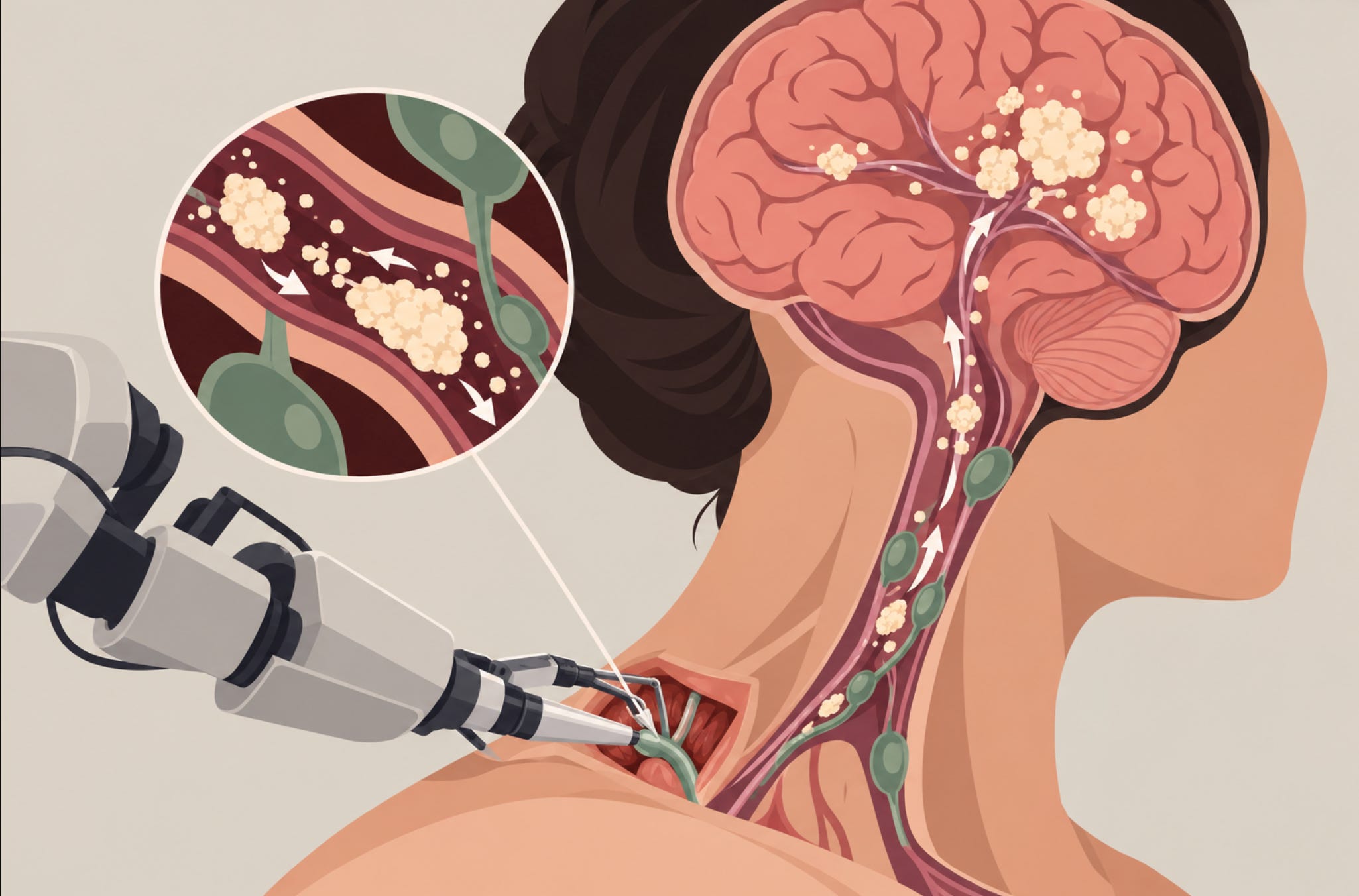
On October 20, 2026, surgeons at the Provincial Specialist Hospital in Słupsk, Poland, performed an unusual operation on a 58-year-old man with early-stage Alzheimer’s disease. They did not open his skull, implant electrodes into his brain, or administer an experimental drug. Instead, they operated on the lymphatic system in his neck.
Over nearly five hours, the surgical team, led by Dr. Daniel Maliszewski, created two connections between cervical lymph nodes and nearby veins, using the Symani robotic microsurgical system. Three additional lymphatic–venous connections were constructed in the lower limbs.
Two days later, the patient was discharged without reported postoperative complications. He also described sleeping better than he had in a long time.
But the most important question remains unanswered: Could improving lymphatic drainage from the brain actually slow Alzheimer’s disease?
The answer could open an entirely new therapeutic direction in neurodegeneration.

Alzheimer’s disease: From targeting proteins to targeting their clearance
Alzheimer’s disease is characterized by several interconnected pathological processes:
Amyloid-β (Aβ) accumulation: Extracellular amyloid plaques are among the earliest detectable pathological features of Alzheimer’s disease.
Tau pathology: Hyperphosphorylated tau aggregates into intracellular neurofibrillary tangles, which are strongly associated with neuronal dysfunction and cognitive deterioration.
Neuroinflammation: Activated microglia and astrocytes contribute to chronic inflammation and potentially exacerbate neurodegeneration.
Synaptic dysfunction and neuronal loss: Progressive disruption of neural circuits ultimately drives cognitive impairment.
For decades, drug development has largely focused on inhibiting the production or aggregation of pathological proteins, or removing them once accumulated. Over the past decade, the amyloid hypothesis—the dominant theory that amyloid-β accumulation drives Alzheimer’s disease—has faced growing challenges. Particularly compelling evidence comes from Dr Yakeel Quiroz’s research on families with hereditary Alzheimer’s disease in Colombia. In a landmark 2019 Nature Medicine study, her team identified a woman carrying the highly penetrant PSEN1 E280A mutation who remained cognitively intact for nearly 30 years beyond her expected age of disease onset, despite extraordinarily high levels of amyloid plaques. Remarkably, she had relatively little tau pathology and carried a protective APOE3 Christchurch variant. In 2023, researchers identified another exceptionally resilient individual carrying the same Alzheimer’s-causing mutation and a rare RELN-COLBOS variant, who remained cognitively intact until age 67 despite extensive amyloid accumulation and relatively limited tau pathology in key brain regions. These findings challenge the notion that amyloid accumulation alone is sufficient to cause dementia and suggest that tau pathology and its anatomical spread may be more closely linked to cognitive decline. They support a more nuanced model in which amyloid may initiate disease processes, while tau pathology is more closely associated with neurodegeneration and clinical symptoms.
The brain has its own waste-clearance system
In 2012, researchers led by Maiken Nedergaard described a brain-wide pathway through which cerebrospinal fluid exchanges with interstitial fluid, facilitating the movement of metabolic waste, including amyloid-β.
This pathway became known as the glymphatic system, reflecting the involvement of glial cells in a lymphatic-like clearance process.
A few years later, researchers identified functional lymphatic vessels in the meninges—the membranes surrounding the brain.
These vessels provide an important connection between the central nervous system and peripheral lymphatic circulation.
The simplified drainage pathway is:
Brain interstitial fluid → cerebrospinal fluid exchange → meningeal lymphatic vessels → deep cervical lymph nodes → systemic lymphatic and venous circulation.
Studies suggest that the efficiency of these clearance pathways may deteriorate with aging and neurodegenerative disease.
Importantly, the glymphatic system is also linked to sleep physiology. Experimental evidence suggests that sleep influences cerebrospinal fluid dynamics and the clearance of metabolic substances from the brain.
This is particularly relevant because sleep disturbances and Alzheimer’s pathology appear to interact bidirectionally.
However, the precise contribution of glymphatic dysfunction to human Alzheimer’s disease—and whether correcting it changes disease progression—remains under investigation.
A surgical shortcut for brain waste removal
The experimental procedure is called deep cervical lymphatic–venous anastomosis (dcLVA).
An anastomosis is a surgically created connection between two anatomical structures.
Lymphatic–venous anastomoses are not themselves new. Microsurgeons have used similar techniques for years to treat conditions such as lymphedema, where impaired lymphatic drainage causes fluid accumulation.
The novelty lies in applying the principle to neurodegenerative disease.
During dcLVA, surgeons connect deep cervical lymphatic structures to nearby veins, theoretically providing an additional route for lymphatic outflow.
The proposed mechanism is straightforward:
Alzheimer’s disease may be associated with impaired drainage of interstitial and cerebrospinal fluid.
Reduced clearance could contribute to the accumulation of amyloid-β, tau and inflammatory mediators.
Surgically creating additional lymphatic–venous connections might decrease resistance to outflow.
Improved drainage could potentially enhance the removal of pathological substances.
Over time, this might reduce neuroinflammation, preserve neuronal function and slow cognitive decline.
The procedure does not directly remove amyloid plaques or tau tangles from the brain. Rather, it attempts to modify the physiological environment responsible for clearing soluble substances.
There is, however, a crucial unresolved assumption: that cervical lymphatic outflow is a meaningful bottleneck in cerebral waste clearance.
If the primary limitation lies upstream—in impaired interstitial transport, altered cerebrospinal fluid dynamics or degeneration of meningeal lymphatics—creating an additional connection in the neck may have limited benefit.
What have clinical studies shown so far?
Although the Słupsk procedure was the first reported operation of its kind in Poland, Chinese teams began exploring cervical lymphatic surgery for Alzheimer’s several years earlier.
By 2026, several clinical reports had appeared, including larger prospective cohorts.
Study 1: 139 patients with severe Alzheimer’s disease
In February 2026, Fu et al (2026) published a prospective, single-arm study in Alzheimer’s & Dementia involving 139 patients with severe Alzheimer’s disease.
Patients underwent dcLVA and were monitored for up to six months.
The investigators reported:
An average improvement of 1.6 points on the Mini-Mental State Examination (MMSE) 48 hours after surgery.
An average MMSE improvement of 1.28 points at six months.
Improvements in reported daily functioning, neuropsychiatric symptoms and sleep.
Changes in Alzheimer’s-related cerebrospinal fluid and plasma biomarkers, including Aβ and phosphorylated tau.
The biomarker findings were particularly intriguing. In a prospective Chinese study involving 139 patients with severe Alzheimer’s disease, researchers observed significant reductions in cerebrospinal fluid (CSF) concentrations of Aβ42 (−176.2, p < 0.001), Aβ40 (−7,706.7, p < 0.001), and phosphorylated tau181 (−37.0, p = 0.004) just 48 hours after surgery. Meanwhile, plasma Aβ40 (+50.3, p = 0.013) and p-tau217 (+3.73, p < 0.001) increased, suggesting a possible redistribution of Alzheimer’s-associated proteins from the central nervous system into the circulation. At six months, plasma Aβ40 and Aβ42 remained significantly elevated, while p-tau217 had fallen below baseline. These results are consistent with the proposed brain-clearance mechanism.
However, the findings need cautious interpretation.
The study had no randomized control group, and only 95 patients completed the six-month cognitive assessment. Moreover, changes in cognitive scores did not consistently correlate with changes in biomarkers.
Most importantly, an improvement of approximately one MMSE point cannot independently establish meaningful reversal of neurodegeneration, particularly in patients with advanced dementia.
In a separate publication, they report “daily living” changes post-op:
t six months, they reported:
Daily functioning (ADL): Significant improvement in activities such as dressing and performing simple household tasks (reported score change −59.5; p < 0.001).
Neuropsychiatric symptoms (NPI): A 9.9-point reduction (p < 0.001), suggesting improvements in behavioral and psychological symptoms.
Caregiver distress (NPI-D): A 3.4-point reduction (p < 0.001).
Sleep (SDI): Significant improvements at one, three, and six months.
Speech and social interaction: Follow-up videos showed patients speaking more spontaneously, responding faster, recognizing family members more clearly, and engaging more socially.
A major regulatory warning
Despite growing clinical interest, China’s National Health Commission prohibited the clinical application of deep cervical lymphatic–venous anastomosis for Alzheimer’s disease in July 2025.
The decision reflected concerns about insufficient evidence supporting efficacy and safety, as well as the premature clinical adoption of the technique.
Important mechanistic questions remain unresolved, including:
Are the surgically created connections consistently patent over time?
What are the actual pressure gradients between the lymphatic and venous systems?
Could venous reflux compromise drainage?
Does the operation measurably increase clearance from brain tissue itself?
Do biomarker changes translate into long-term preservation of cognition?
I do wonder to what extent it was prohibited so that the unaccredited, wannabe longevity medicine centers (that have nothing to do with real longevity medicine) don’t start mass offering it for “improved brain clearning”. If you want to understand the real longevity medicine, see Longevity Education Hub
What would convince us that it works?
In my view, demonstrating a patent connection between a cervical lymphatic structure and a vein is only the beginning.
A convincing proof of mechanism would require showing that this peripheral surgical intervention actually improves cerebral clearance.
Ideally, future trials would combine several complementary measurements:
1. Direct or indirect physiological measurements
Quantify changes in lymphatic flow, anastomotic patency, venous reflux and cerebrospinal fluid clearance dynamics.
2. Molecular biomarkers
Monitor plasma and cerebrospinal fluid Aβ42/40, p-tau217, p-tau181, neurofilament light chain (NfL) and glial fibrillary acidic protein (GFAP).
These could help distinguish changes in amyloid pathology, tau pathology, neuronal injury and astroglial activation.
3. Molecular imaging
Use amyloid and tau PET to determine whether the intervention changes cerebral pathological burden over time.
4. Clinical outcomes
Measure cognitive trajectories using validated instruments such as CDR-SB and ADAS-Cog, alongside daily functioning, caregiver-reported outcomes and quality of life.
5. Appropriate control groups
Randomized controlled trials are essential to distinguish surgery-associated effects from placebo responses, changes in postoperative care, measurement variability and other confounding factors.
The planned Polish follow-up includes cognitive testing, blood biomarkers, sleep measurements and MRI-based assessment of clearance physiology.
The team has authorization for 15 experimental procedures, with the first patient expected to be followed for at least two years.
Meanwhile, controlled trials such as CLEAN-AD are being developed to evaluate cervical lymphatic–venous surgery more systematically.
How does this compare with existing Alzheimer’s therapies?
To appreciate why an entirely different approach is attracting attention, it is useful to understand what current treatments can—and cannot—achieve.
Historically, most approved Alzheimer’s medications have focused on managing symptoms rather than altering the underlying disease.
That changed with the arrival of anti-amyloid monoclonal antibodies.
Disease-modifying therapies: Anti-amyloid antibodies
The introduction of monoclonal antibodies targeting amyloid-β represented an important shift from symptom management toward treatment of underlying pathology.
Two leading approved therapies are lecanemab and donanemab.
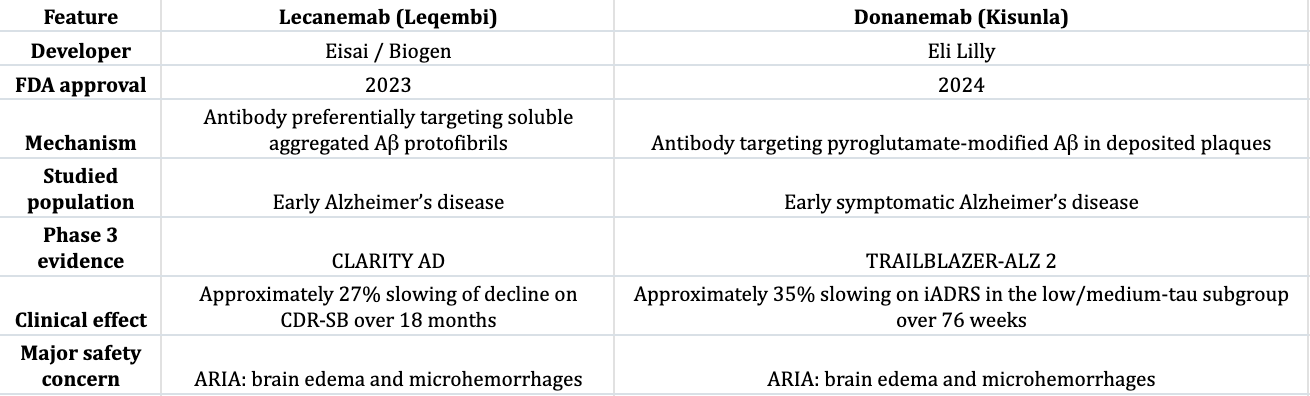
These percentages are relative reductions in decline on different clinical scales and populations. They should not be interpreted as a direct head-to-head comparison.
Lecanemab
In the Phase 3 CLARITY AD study involving 1,795 participants with early Alzheimer’s disease, lecanemab significantly slowed clinical decline compared with placebo over 18 months.
The trial reported a 27% reduction in decline measured using the Clinical Dementia Rating–Sum of Boxes (CDR-SB).
This was an important demonstration that directly targeting amyloid pathology could produce a measurable clinical benefit.
In 2026, the FDA also approved a subcutaneous starting regimen, allowing suitable patients to administer lecanemab at home rather than relying exclusively on intravenous infusion facilities.
Donanemab
In the Phase 3 TRAILBLAZER-ALZ 2 study, donanemab slowed clinical decline by approximately 35% on the integrated Alzheimer’s Disease Rating Scale among participants with low-to-medium tau pathology.
Across the broader combined trial population, slowing on that measure was approximately 22%.
Donanemab demonstrated substantial amyloid plaque reduction, and treatment protocols permit discontinuation after amyloid clearance reaches predefined thresholds
These treatments are important advances, but they have several limitations.
First, they slow rather than reverse cognitive deterioration.
Second, their pivotal efficacy evidence comes primarily from patients with mild cognitive impairment or mild dementia due to Alzheimer’s disease.
This necessitates patient selection, MRI surveillance and careful consideration of risk factors such as APOE ε4 genotype.
Finally, amyloid removal addresses only one component of Alzheimer’s pathophysiology. Tau pathology, neuroinflammation, mitochondrial dysfunction, vascular abnormalities and synaptic degeneration remain highly relevant therapeutic targets.
Active Phase 2/3 trials for AD
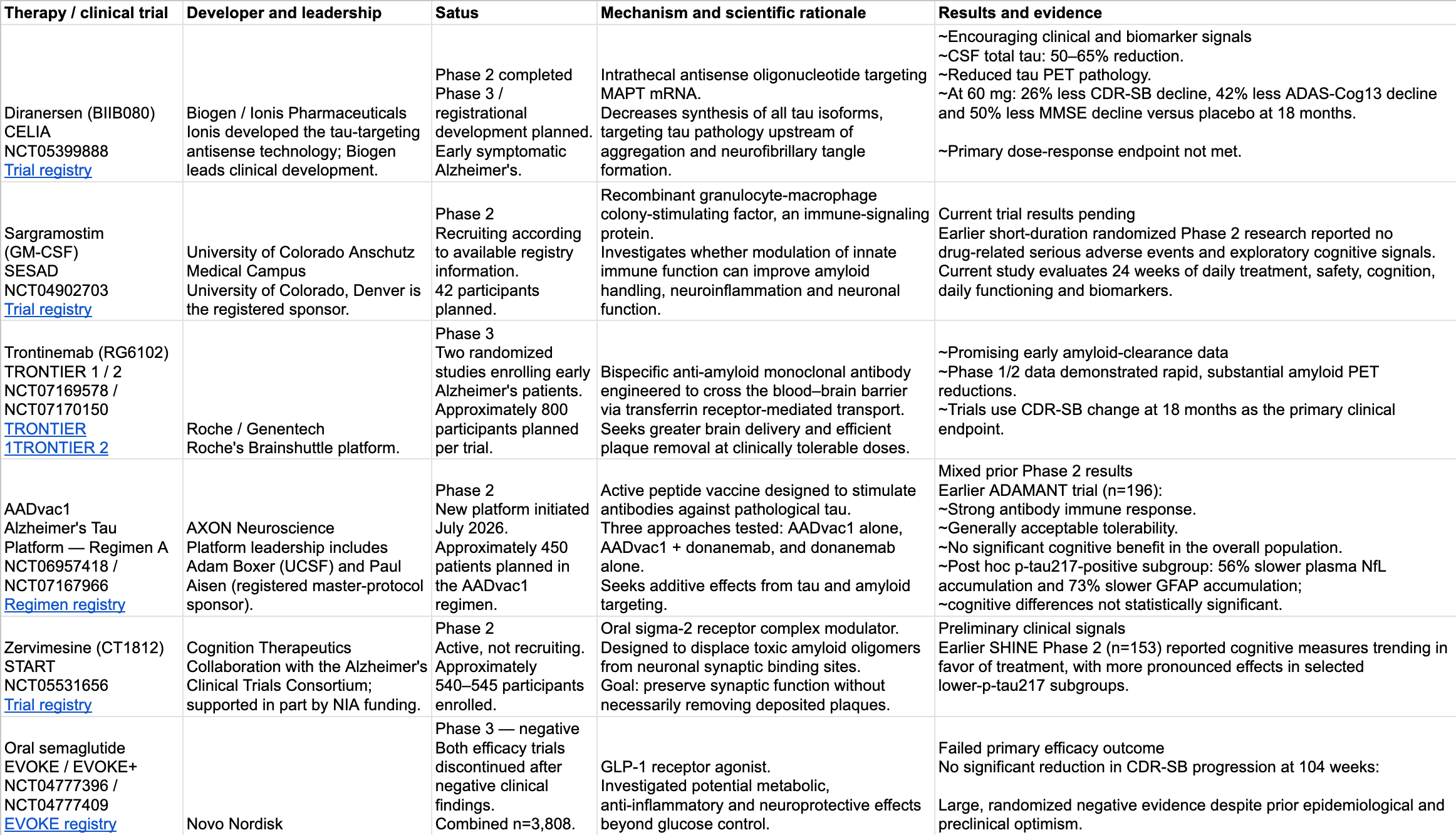
Beyond the recently approved anti-amyloid antibodies, the Alzheimer’s therapeutic pipeline is becoming increasingly diverse, with clinical trials targeting tau pathology, neuroinflammation, synaptic dysfunction, and blood–brain barrier delivery. Among the most promising is diranersen (BIIB080), an antisense oligonucleotide targeting tau production, which demonstrated substantial reductions in CSF tau and encouraging cognitive outcomes in Phase 2, although its primary endpoint was not met (dose-response relationship in CDR-SB). Other innovative approaches include sargramostim, which modulates innate immunity; trontinemab, Roche’s next-generation anti-amyloid antibody engineered to cross the blood–brain barrier more efficiently; AADvac1, an active tau vaccine being investigated in combination with donanemab; and zervimesine, an oral small molecule designed to protect synapses from toxic amyloid oligomers. However, the field continues to face significant translational challenges. Most notably, Novo Nordisk’s large Phase 3 EVOKE and EVOKE+ trials failed to demonstrate that semaglutide slows cognitive decline, despite strong preclinical and epidemiological rationale.
A new direction for neurodegenerative medicine?
When I first became involved in the Alzheimer’s field seven years ago, the disease was still largely surrounded by silence and stigma, and there was nothing anyone could do about the disease (to an extent that would significantly delay the onset/ammeliorate daily life to a great extent). People rarely talked about it, and many never received a diagnosis. In some ways, that reluctance was understandable: why would someone want to know they were developing an incurable disease when there was so little medicine could offer? Seven years later, the landscape looks remarkably different. An d7 years is really not that long from a pharma perspective! We now have blood-based biomarkers, the first disease-modifying therapies, and an increasingly diverse pipeline of approaches that would have seemed almost unimaginable back then. Early diagnosis is becoming genuinely actionable, even if our therapeutic options remain far from sufficient. To me, this fundamentally changes the conversation around Alzheimer’s: knowing one’s risk or diagnosis is no longer just about preparing for an inevitable decline, but increasingly about having an opportunity to intervene. Of course, the decision to know or not to know must remain the individual’s choice, particularly when it comes to genetic risk. But that choice carries a different meaning when something can actually be done. Looking at how much has changed in just seven years, I find it difficult not to be excited about what the next seven might bring. For the first time since I entered this field, optimism about the future of Alzheimer’s treatment feels grounded in more than hope
Good writeup! There are going to be some emerging molecular designs that try and mimic this clearance function. Leveraging brain shuttles to facilitate efflux from the cns, not just influx. I might have inside info 😉. Lmk if interesting.
Dominika, Congrats to you and Alex Zhavoronkov! Here's an interesting article on the first Longevity Couple https://www.forbes.com/sites/alexzhavoronkov/2022/02/14/forever-in-love-and-in-love-with-forever-introducing-the-worlds-first-true-longevity-couple/
Also, here's a link to a neuro nano-robotics company--> https://robeaute.com/